
 |
| David Pratten examining Nigerian masks © Pitt Rivers Museum |
In July, social
anthropologist David Pratten visited the Pitt Rivers Museum to examine the African masks
associated with the Annang
and Ibibio peoples of
Nigeria. David has spent a
significant period of time in south-eastern Nigeria
working with Annang villagers and kindly brought along his video clips and
photographs to show me how they use masks in the present day. David has written extensively about Nigeria and other subjects and you can find a list of his published works here.
David explained that each mask is unique as they are individually hand-carved, although common characteristics are often
incorporated; he pointed out the number of blackened masks in the
collection, which, like those below, often have bulging cheeks, horns and distorted
features (said to depict gangosa, a facial disease).
 |
|
Masks donated to the Museum by W. E.
Aston-Smith in 1936
|
 |
PRM 1914.26.15 © Pitt Rivers Museum
|
David told me this style of mask is
associated with the Ekpo Secret
Society, whose membership is restricted to Annang and Ibibio men. Men are
accepted into this Society by an initiation process. Ekpo is
based on belief in the afterlife; indeed the word Ekpo means 'ancestor'. Members wear masks at the funerals of fellow members and during the Ekpo
masquerade season, which usually occurs annually at the end of the harvest in
October.
When we turned the masks over to look at the reverse side, we could see a series of holes around the edge of each and David
pointed out that these are used to string raffia through before the mask is worn. The
only one in the collection with raffia attached is this one, which is one of
the oldest Ibibio masks in the collection, given to the Museum by Percy Amaury Talbot
in 1914.
David then showed me his photographs of masks in use by Ekpo
masqueraders - each person wearing a mask and raffia costume, along with charcoal and
oil rubbed into the skin to give a shiny black appearance.
 |
| Ekpo masqueraders © David Pratten |
Before the British colonized the area
that came to be known as Nigeria, Ekpo is said to have acted as a form of
government, serving a political, legislative, judicial and religious function
in Annang and Ibibio village life. The Museum collection includes masks given
by Percy Amaury
Talbot in 1914 and Gwilym
Iwan Jones in 1938. Both worked for the Colonial Service in
Nigeria. Fortunately both Talbot
and Jones
published books, which include their experiences of Ekpo during their time there. Talbot
in particular describes court cases where it would seem that the activities of members of
the Ekpo Society - notably with regard to regulating society - often came into conflict with the Nigerian Colonial
Administration as well as missionary and church congregations. Ekpo
continues to perform, but over many decades the masquerade has been criminalized by the government and demonized by the churches.
To their proponents, Ekpo masquerades are regarded as a means
through which the ancestors communicate with the living. When a man wears an
Ekpo mask he becomes a masked spirit, who still often performs a reprimanding
role, for instance by naming and shaming those who have done wrong in the
community.
 |
| Ekpo masquerades © David Pratten |
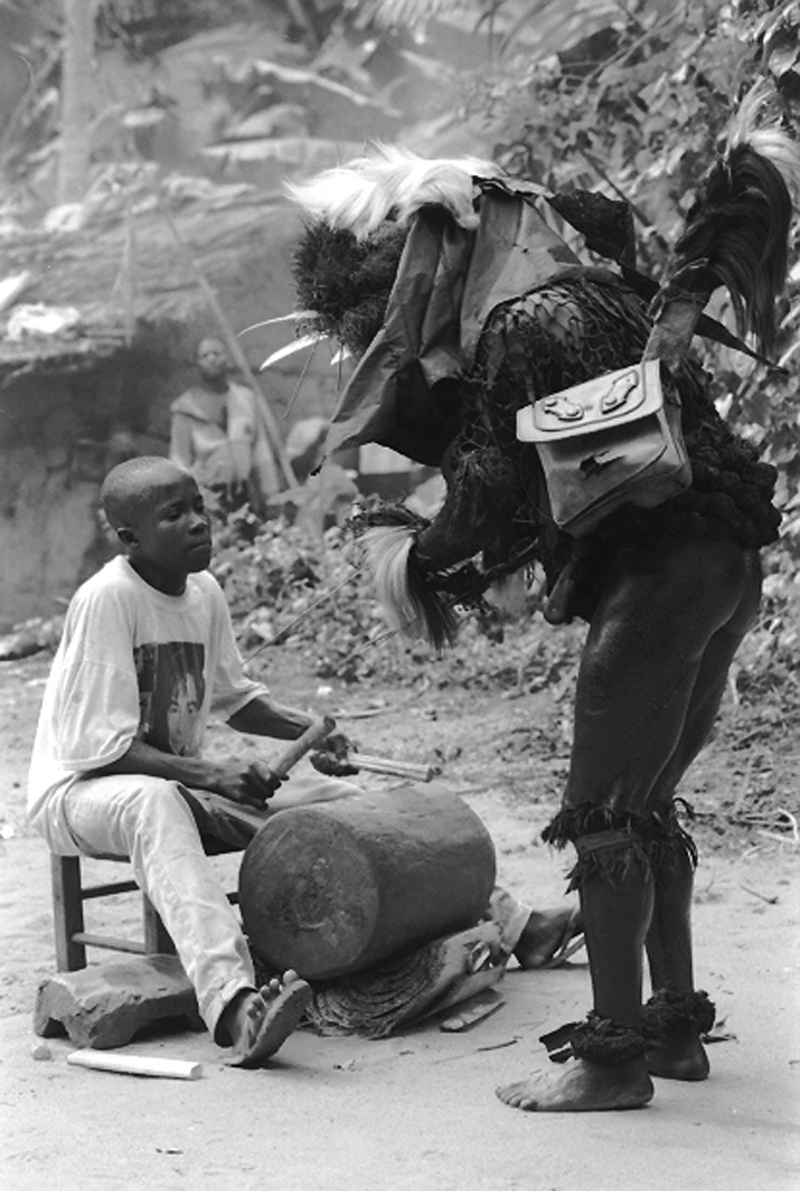 |
| © David Pratten |
During the Ekpo season, masqueraders are
seen around the villages and performing in market places. The blackened
masks are intended to look fierce and dangerous to onlookers. Wearing the mask transforms the masquerader into a spirit who may need to be physically
restrained if the spirit is particularly malevolent, and such control over a malevolent
spirit may be achieved through the sound of accompanying drumming.
The masquerade costume can include a bow
and arrows and David described how an arrow is sometimes shot at a man so that it
lightly pierces his skin. This serves as an invitation to be initiated into the
Ekpo Secret Society. The man in question pays a fee for such an honour, so he can pay for medicine to heal the surface wound.
Looking at the Museum's collection, David
explained that some Ekpo masks can be regarded as beautiful (mfon), others as ugly
(idiok) and that many have particular names and roles. Some spirits are
benevolent, others malevolent. Unfortunately we do not have such
detailed information about the Ibibio and Annang masks in the collection. The
appearance of Ekpo masks can vary so much over time and from place to place
that now we can only really speculate about what they might represent.
 |
| Ekpo masqueraders with bows and arrows © David Pratten |
David took this five-minute video showing three Ekpo
masqueraders in 2008 at a burial in the village of Ikot Esa, Akwa Ibom State. If you
watch, you will see the masqueraders performing rites on the grave of a
deceased member, parading around the village singing, plus collecting money
from passers by.
My thanks to David for coming and sharing all this wonderful information. I am continuing to contact specialists from the UK and beyond to
find out more about the African masks in the Pitt Rivers Museum collections to help us improve our knowledge about them and help us as we prepare new displays. Keep an
eye on this blog and I will keep you posted!
Zena (email me)
Suggested Further Reading
- Akpabot, Samuel, 1975/1976, ‘The Talking Drums of Nigeria’ African Music 5 (4): 36-40.
- Akpan, Joseph J., 1994, ‘Ekpo Society Masks of the Ibibio’ African Arts 27 (4): 48-53 & 94-95.
- Ekpa, Aniedi E., 2012, ‘The Dynamics of Music and Culture in Traditional Ibibio Society of Nigeria’ African Research Review 6 (2): 90-101.
- Forde, Cyril Daryll and Jones, G.I., 1950, The Ibo and Ibibio-speaking peoples of south-eastern Nigeria. London: International African Institute by Oxford University Press.
- Jones, G.I., 1984, The Art of Eastern Nigeria. London: Cambridge University Press.
- Offiong, Daniel A., 1984, ‘The Functions of the Ekpo Society of the Ibibio of Nigeria’ African Studies Review 27 (3): 77-92.
- Offiong, Daniel A., 1982, ‘The Process of Making and the Importance of the Ekpo Mask’ Anthropologica 24 (2): 193-206.
- Pratten, David, 2008, ‘Masking Youth: Transformation and Transgression in Annang Performance’ African Arts 41 (4): 44-60.
- Simmons, Donald C., 1957, ‘The Depiction of Gangosa on Efik-Ibibio Masks’ Man 57: 17-20.
- Talbot, Percy Amaury, 1923, Life In Southern Nigeria. London: MacMillan and Co.


