Showing posts with label handling collections. Show all posts

Wednesday, 21 December 2016

Textiles in Focus Day

Event Poster
On the 29th October, the Museum was - or so it felt - entirely taken over by textiles! Working collaboratively with Conservation staff and the Collections team, the Need/Make/Use team developed an event to showcase pieces from the textile collections and offer hands-on and behind-the-scenes opportunities for visitors. In particular, we set out to highlight textiles collected by Sheila Paine during her fieldwork throughout East and Central Asia. From 16th August 2016 through to 12th February 2017, you can see a special display on the first floor of the Museum entitled Stitch of a Symbol - Insights into the textile journeys of Sheila Paine. You can read a great article about Sheila Paine here.


Stitch of a Symbol gallery display
Going behind-the-scenes
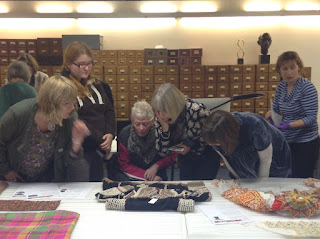
Visitors were able to book a place on a special behind-the-scenes talk led by Curator and Joint Head of Collections, Julia Nicholson. Visitors were able to see close-up objects specially taken off of display and retrieved from the Museum's stores. 


Textiles in the research space © Pitt Rivers Museum
Curatorial Assistant, Nicholas Crowe, and Curator and Joint Head of Collections, Julia Nicholson, laying out objects in the research space ready for the tours. 


Visitors in the research space © Pitt Rivers Museum
Beautiful and intricate objects were laid out in the research space. Visitors were able to take photos, hear Julia talk about how the objects were acquired and learn a bit about their history. It was excellent to hear many of the visitors puzzling between themselves about how they thought garments were constructed and exactly how decorations were applied. Through opportunities such as this, we hope to facilitate visitors to get thinking about the intricacies of construction and about the individuals who made - and still make - such objects.

Floral brocaded ribbon (Slovakia 2008.117.5) © Pitt Rivers Museum
Mola (Panama, 1924.46.74) © Pitt Rivers Museum

Waistcoat and blouse (Slovakia, 2008.117.1-.2)
© Pitt Rivers Museum
Tapestry panel (Peru, 1952.7.69) © Pitt Rivers Museum


Huipil blouse (Guatemala 1990.46.1) © Pitt Rivers Museum
Visitors in the research space © Pitt Rivers Museum

Weaving demonstrations and object handling
The balcony space on the first floor was filled with textiles from our handling collections - visitors were able to pick up and look closely at all sorts of objects - contrasted in different ways - from around the world. One of the days highlights was Head of Conservation, Jeremy Uden, demonstrating weaving on an 8 shaft loom. Visitors of all ages seemed to find this intricate and time consuming work really interesting and asked many questions throughout the day! With help from VERVE volunteers, people could also have a go at weaving on a 4 shaft loom. 


Head of Conservation, Jeremy Uden, demonstrating
an 8 shaft loom. © Pitt Rivers Museum
Visitor using a 4 shaft loom © Pitt Rivers Museum


Volunteers and visitors have a go at 4 shaft loom weaving using patterns designed by Jeremy Uden, Head of Conservation. 


Colourful handling objects © Pitt Rivers Museum

Handling objects - Huipil blouses from Guatemala (2016.223.edu and 2016.219.edu) and a backstop loom likely to be from South America (2002.168.edu). 


Handling object - toy doll in traditional Uzbek dress
(2016.608.edu) © Pitt Rivers Museum 

Coffee and cross stitch  
To finish off their visit, we invited people to join VERVE staff and volunteers for a coffee and to have a go at cross stitch in our seminar room. Each cross stitch design had been specially created by VERVE volunteers and reflected patterns found on the women's hats in the Sheila Paine collection. People could take away patterns and the work they had begun to continue cross stitching in their own time. Some visitors said that this was the first time they had cross stitched since childhood and that they now felt inspired to keep going with the craft. Others had never tried cross stitching before and learnt a new skill whilst also connecting with the collections in a new way. 


Designs based on 2008.116.22 - a panel made for a
women's skull cap © Pitt Rivers Museum
Cross stitching © Pitt Rivers Museum
Finished cross stitch © Pitt Rivers Museum
A new convert to cross stitching shows off her completed design! 


All in all, Textiles in Focus Day was a real success, offering more than 400 visitors the chance to closely examine the textiles in the collections and get some insight into the people who still make and use such items today. 

Keep an eye on our what's on pages for information about other events like this one ... in 2017 we are offering monthly hands-on workshops (such as prehistoric knife making!) that provide the chance to explore the making methods behind objects in the collections. 

Jozie Kettle
VERVE Programming and Communications Officer

Wednesday, 14 December 2016

Out in Oxford: handling collection

Helena Fox volunteered at the Pitt Rivers Museum assisting with preparations for activities during LGBT+ History Month in 2017.  We asked Helena to explore our Object Handling collection.  Here are her experiences: 

From 28th November to 2nd December I had the opportunity to undertake work experience at Pitt Rivers Museum.  One of the tasks I had was to search the Museum’s Object Handling Database to find items which could be used as part of the Pitt Rivers’ Out in Oxford LGBT+ History Month in February 2017. Here, I want to highlight two objects which I feel have a particularly pertinent part to play in contemporary discussions around LGBTQ+ issues.

Mask 2002.160.edu © Pitt Rivers Museum

The first object I have picked is the collection’s carved wooden face mask, called a Mwana Pwo mask, of the Chokwe people of Angola and the Democratic Republic of Congo. These masks, depicting the ideals of female beauty, are used in initiation ceremonies to promote fertility and honour the women of the communities in which they are used. However, Mwana Pwo masks are always worn by men who dress as women and skilfully mimic female movements during performances. For me, the mask evokes conversations I have had about the huge scope of different gender identity expression, such as is seen in the hugely popular TV show, RuPaul’sDrag Race. The Mwana Pwo masks are objects of great importance and respect; they are so revered that it is said they are buried with the masqueraders. In my opinion, these masks speak of widespread respect for the fluidity of gender expression and the many different forms which this can take, and this is highly relevant to LGBTQ+ discourse today.

Kohl flask and applicator 2016.75.1.edu and 2016.75.2.edu © Pitt Rivers Museum

The second item which struck me as especially interesting is the collection of kohl flasks. I was grasped by two things: first, that kohl is associated with both practical and aesthetic uses, and secondly that, in Ancient Egypt, it was worn by men, women and children. Kohl’s practical applications included belief in the protection it provided against harsh sunlight, ailments and being cursed by the Evil Eye. Kohl is now known to have qualities which boost the immune system and help ward off potentially dangerous bacteria. This universal wearing of eyeliner, be it for practical, cultural or aesthetic reasons, made me think about our perception of makeup as an inherently female, or at least feminine, item. Consequently, we tend to associate men wearing makeup with a certain level of femininity and therefore an assumption of them being gay, as fits into the ‘gay best friend’ model of a camp man providing fashion and makeup advice. To qualify our unease with men wearing makeup, especially men we see as far too masculine to be gay (which is, in itself, an odd conclusion, as levels of ‘feminine’ and ‘masculine’ behaviour cannot denote sexuality), we use terms like ‘male grooming’ and ‘guy liner’. Reading about male and female usage of kohl (made iconic in the images of Tutankhamun and Cleopatra so synonymous with our perception of Ancient Egypt) made me consider how strange our gendering of makeup is, and how we use this to presume people’s sexualities when we really have no basis to go on. 

Kohl flask and applicator 2016.9.1.edu and 2016.9.1.edu © Pitt Rivers Museum

I will leave you with this: next time you go to talk about someone wearing ‘guyliner’, why not try simply ‘eyeliner’? Is there really any difference?

Helena Fox
Volunteer

Thursday, 5 September 2013

NMU Day 2013: Sunshine, Yarnbombing and Drums galore...


© Pitt Rivers Museum Source

So our inaugural Need / Make / Use Day is over and what fun it was! The NMU team arrived bright and early to set up and our excitement - plus, if I’m honest, our trepidation  - built as demonstrators, wokshoppers and craft makers started to arrive. Would the public show up? Would it rain? Did we forget anything? Where were our balloons? Have we collected enough ‘rubbish’ for the junk workshops?

© Pitt Rivers Museum Source

Thankfully, the weather was on its best behaviour, we found supplies were ample, volunteers were prepared to undertake a variety of tasks, and the public were fantastic, turning up in healthy numbers throughout the day. We had hoped for perhaps 1000 people but in the end we had more than 1600. We were really pleased with this, especially as on such as sunny day, people might have chosen a million other places to go and we were competing against a local beer festival, a food festival and an Oxford United home game! Interestingly, it was the adults who sometimes got more enthused by the instrument-making, weaving, face-painting and craft activities, which is great - VERVE is all about trying to get people in touch with their creative sides and thinking about the making skills they have, have forgotten or might want to develop.

© Pitt Rivers Museum Source

The first event of its kind to be hosted by the Pitt Rivers, NMU Day 2013 was a bit of a test year – a practical and theoretical space for the NMU team to work in collaboration with some fantastic partners in order to explore what public outreach on a large scale should include. Most of you know how short we are on space inside the Museum so an outdoor event seemed the best way to allow as many people as possible experience a little of the Pitt Rivers magic. New things were tried and tested and on the whole, everything went well - all of the workshops and making activities went smoothly; 'dressing up for survival' produced some interesting sartorial creations (we love the mini 'Livingstone in Africa' below!); craft sellers helped make a lovely handmade market atmosphere; kids with baked bean tin drums made their debut with the brilliantly entertaining Sol Samba musicians; highlights tours and architecture talks were well-attended; and finally, we learnt that kiwi coffee, freshly baked pizza and ice cream are fantastic accompaniments to crafty and ethnographic fun!

© Pitt Rivers Museum Source

© Pitt Rivers Museum Source

Flicking through the Need / Make / Use Day visitor feedback book, my heart sunk as I came across a comment opening with ‘RUBBISH...’ However, reading on, the author finished with ‘…is great! What fun’. Phew! It was fantastic to see so many people – young and old, locals and those from further-a-field – so engaged by the interactive activities on offer. You can find lots of photos from the day on our Flickr site.

Thank you to all of you who took part  - it wouldn't have happened without you. For a full list of participants, see our previous post. If you made it to NMU Day 2013, do leave a comment below and let us know what aspects you got involved with. If you didn't make it, we look forward to seeing you next year! 

Keep an eye on our website for the date of NMU Day 2014. In the meantime, feel free to email me (Jozie) for further info. 


Jozie

Thursday, 27 June 2013

Oh, What a Circus! The Pitt Rivers tent on tour


Last week the Need, Make, Use team ran away with the circus! For a couple of days we teamed up with the 1930s-style Gifford Circus - a perfect fit for the project's focus this year on performance and music.

After much preparation for the event ordering and sorting art materials, printing out templates, creating prototypes we loaded up the van with tables, chairs, equipment and miles of bunting and set off for the lovely village of Stadhampton, around 9 miles from Oxford. Our excitement grew as we rounded a bend and saw the Big Top commanding the village green, surrounded by retro caravans. This year, the Giffords performance involves some hilarious puppets, so we thought it was the perfect opportunity to bring along the Museum’s considerable collection of beautiful Indonesian shadow puppets and give families a chance to make their own!


We set up in an adjacent tent, decorating it with bunting and pictures, and laying out our wares in time for the visitors arriving pre-show. The atmosphere at the circus was lovely with our chandelier-lit tent (we might ask to replace our ordinary office lights with chandeliers!), riders rehearsing outside, and the performers putting on their costumes and greasepaint - a great atmosphere in which to demonstrate the playfulness of some of the Museum’s objects. 

We had brought wayang kulit - puppets used in Indonesia, especially on the islands of Java and Bali - to perform shadow plays. Visitors got to touch and play with the intricate puppets - hand-made from buffalo skin, horn and bamboo - and hear recordings of the gamelan music that traditionally accompanies the performances. 

Volunteer Olly with some Indonesian shadow puppets

Our puppets were characters from the Ramayana (you can see some traditional shadow puppet characters here) and it was nice to see recognition on children's faces who knew the story from lessons at school. We also took with us this short video made by UNESCO demonstrating the puppets in action so people could get a real sense of the skill, movement and context involved.


Families could then, if they wanted, make their own versions of Prince Rama, Princess Sita, the demon Ravana, or the monkey god Hanuman and perform with them in our mini, portable puppet theatre. The glorious Midsummer sunshine, although appreciated, did make getting shadows from torches a little difficult at times, but the team were able to improvise using the ready-made theatre of the tent walls and the sun!


Video (90 seconds) of the puppet theatre booth in action!


It was great to take our event to people outside Oxford who might not have heard of the Museum, or realised just how close they are to it, or who maybe needed some inspiration to re-visit. More than 350 people of all ages flowed through the tent over the course of the two evenings, including some of the circus performers who were curious to learn about other performance traditions from another side of the globe. In turn, we had the chance to watch the spectacular circus ourselves before rushing back to take the puppets out to greet people during the interval.


All in all, the event was a great success and a lot of fun, with one visiting parent commenting, "This was an absolute joy – wonderful to have the children distracted during the interval and continuing the creative process! Thank you. More please!"

For more information about shadow puppets, the Multicultural Canada website features an interesting collection held at the Simon Fraser Museum of Archaeology and Ethnology.

Giffords Circus info and tickets here.

Alex Ross, volunteer

Sunday, 5 May 2013

A bright start to VERVE's events programme


The end of April saw one of VERVE's busiest weeks in terms of events so far...proving a lot of hard work to make them a success but also a lot of fun too!

A Friday night hosting a group of suited and booted finance managers from the Saïd Business School - introducing them to some of the histories and highlights of the Museum - was followed by a weekend shifting gear to focus on family groups - a nice illustration of the variety of audiences VERVE aims to involve.

We loaded up the van with bells, bunting and biscuits and made our way to Oxford Castle for our first outreach event at Folk Weekend Oxford. It was a beautiful setting in the gardens of the old prison in glorious sunshine. To fit with both the folk theme and the music and performance focus of VERVE in our first year, we offered families the chance to get hands on by making their own morris dancer's knee bell pads or handling some of our global instrument collections - from a Turkish drum to a Chilean rainstick to a West African kora. 


The Pitt Rivers tent at Oxford Castle Gardens

Children chose different coloured ribbons to decorate their knee pads, in the
same way that Morris dancers have distinguishable 'team' patterns and colours.

A Pitt Rivers volunteer demonstrates the silky sound of the kora

Visitors guess how to play some our
instruments and where they're from

Visitors could also watch and listen to demonstrations by our two special guests: Anna Casserley, who introduced vthe Cornish tradition of hand-whittling 'May whistles' from willow branches, and Michael Wright, a renowned authority on the mysterious Jew's harp - an ancient mouth instrument with a surprisingly futuristic sound. We have an extensive collection in the Museum.

We have a busy summer schedule of tent outings so this was a fantastic way to start  - more than 450 people of all ages had a taste of Pitt Rivers in the tent, including many people who had not been to, or even heard of, the Museum before.

Jew's harp expert Michael Wright demonstrates the instrument 
Iron and steel Jew's harp, China PRM 1932.89.248

A few days later we hosted our first Twilight Takeover event, an initiative to work with young people to help them organize and curate a social evening at the Museum. The many weeks of careful planning paid off - more than 200 people came to experience the Museum with atmospheric lighting, music, bellydancing and contemporary dance choreographed by Rosie Kay. The 'Mask Parlour' was particularly popular, buzzing with industry and imagination. It just goes to show, we are all kids at heart! In addition, we were amazed and impressed by those who came with their own masks - everything from carnival ones to Venetian ones to horror ones.

Guess who? Masked guests at the Masquerade event

Videographer Dan Keeble made this wonderful short film of the night (3 mins) and the student organizers will write a fuller account for this blog soon.


Then, with just enough time to draw breath, we hosted our second Skills in the Making workshop in partnership with NSEAD. Artists Caroline Broadhead and Julie Westbury came from London to deliver a full-day session for 16 Oxfordshire art teachers. Participants were asked to bring a few items such as scissors and a sketchbook and a camera to record both their own work and that of other people. The theme was the 'Performing Objects' and people were asked to think about creating a piece that would in some way change the body's appearance, conceal it, restrict its movement or impact on the wearer's 'personal space'. In this the Museum's Body Arts collections were an obvious inspiration.

After the artists showed a powerpoint of their own work and approaches, the participants were let loose with a variety of materials including flexible furniture cane, coloured thread, wax paper, plastic bands, plastic fibres, foil and newspaper. Soon, a plethora of inventive accessories started taking shape, from rings and ruffs, to head-dresses and hats. Julie and Caroline encouraged everyone to think in new ways - "what if you turned it this way?" or "what sort of sound does it make when you move in it?" Many pieces were items that restricted the senses, such as vision, touch or even breathing. Each person explained their pieces to the rest of the group and many reported how uneasy this stifling of the senses made them feel - the voluntary denial of interaction with one's environment.


An alternative fascinator


The wearer said her brain tried to
'fill in the gaps' in her stripy vision

A punky hand ornament, reminiscent of
some of the Museum's knuckledusters

Dubbed an 'isolation bridle' and inspired by cane-work,
this contraption was designed to keep the wearer's
hands in the correct position when making
quills - a mediative, repetitive action.

This striking cone visor started off as a finger
ornament, then increased in scale!

By the end of the day there had been an impressive array of sculptural forms made and everyone took interest in each other's work and discovering new ways of working. Feedback from the teachers was positive. One noted, "a good opportunity to make some work for myself and nice to chat to others about how we can use and recycle everyday objects." After the success of our two Skills in the Making workshops we will be meeting with NSEAD and OAT (Oxfordshire Art Teachers) network to see how we can take the partnership forward. 

So, in little over a week, VERVE has involved more than 750 people from all backgrounds and interests, built relationships with all sorts of new groups, and constructed outreach and workshop models we can take forward into the future. All good stuff, and now the team can put its feet up for a little while before our big summer programme starts - watch this space..!