Showing posts with label HLF. Show all posts

Wednesday, 21 December 2016

Textiles in Focus Day

Event Poster
On the 29th October, the Museum was - or so it felt - entirely taken over by textiles! Working collaboratively with Conservation staff and the Collections team, the Need/Make/Use team developed an event to showcase pieces from the textile collections and offer hands-on and behind-the-scenes opportunities for visitors. In particular, we set out to highlight textiles collected by Sheila Paine during her fieldwork throughout East and Central Asia. From 16th August 2016 through to 12th February 2017, you can see a special display on the first floor of the Museum entitled Stitch of a Symbol - Insights into the textile journeys of Sheila Paine. You can read a great article about Sheila Paine here.


Stitch of a Symbol gallery display
Going behind-the-scenes
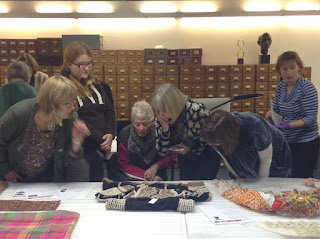
Visitors were able to book a place on a special behind-the-scenes talk led by Curator and Joint Head of Collections, Julia Nicholson. Visitors were able to see close-up objects specially taken off of display and retrieved from the Museum's stores. 


Textiles in the research space © Pitt Rivers Museum
Curatorial Assistant, Nicholas Crowe, and Curator and Joint Head of Collections, Julia Nicholson, laying out objects in the research space ready for the tours. 


Visitors in the research space © Pitt Rivers Museum
Beautiful and intricate objects were laid out in the research space. Visitors were able to take photos, hear Julia talk about how the objects were acquired and learn a bit about their history. It was excellent to hear many of the visitors puzzling between themselves about how they thought garments were constructed and exactly how decorations were applied. Through opportunities such as this, we hope to facilitate visitors to get thinking about the intricacies of construction and about the individuals who made - and still make - such objects.

Floral brocaded ribbon (Slovakia 2008.117.5) © Pitt Rivers Museum
Mola (Panama, 1924.46.74) © Pitt Rivers Museum

Waistcoat and blouse (Slovakia, 2008.117.1-.2)
© Pitt Rivers Museum
Tapestry panel (Peru, 1952.7.69) © Pitt Rivers Museum


Huipil blouse (Guatemala 1990.46.1) © Pitt Rivers Museum
Visitors in the research space © Pitt Rivers Museum

Weaving demonstrations and object handling
The balcony space on the first floor was filled with textiles from our handling collections - visitors were able to pick up and look closely at all sorts of objects - contrasted in different ways - from around the world. One of the days highlights was Head of Conservation, Jeremy Uden, demonstrating weaving on an 8 shaft loom. Visitors of all ages seemed to find this intricate and time consuming work really interesting and asked many questions throughout the day! With help from VERVE volunteers, people could also have a go at weaving on a 4 shaft loom. 


Head of Conservation, Jeremy Uden, demonstrating
an 8 shaft loom. © Pitt Rivers Museum
Visitor using a 4 shaft loom © Pitt Rivers Museum


Volunteers and visitors have a go at 4 shaft loom weaving using patterns designed by Jeremy Uden, Head of Conservation. 


Colourful handling objects © Pitt Rivers Museum

Handling objects - Huipil blouses from Guatemala (2016.223.edu and 2016.219.edu) and a backstop loom likely to be from South America (2002.168.edu). 


Handling object - toy doll in traditional Uzbek dress
(2016.608.edu) © Pitt Rivers Museum 

Coffee and cross stitch  
To finish off their visit, we invited people to join VERVE staff and volunteers for a coffee and to have a go at cross stitch in our seminar room. Each cross stitch design had been specially created by VERVE volunteers and reflected patterns found on the women's hats in the Sheila Paine collection. People could take away patterns and the work they had begun to continue cross stitching in their own time. Some visitors said that this was the first time they had cross stitched since childhood and that they now felt inspired to keep going with the craft. Others had never tried cross stitching before and learnt a new skill whilst also connecting with the collections in a new way. 


Designs based on 2008.116.22 - a panel made for a
women's skull cap © Pitt Rivers Museum
Cross stitching © Pitt Rivers Museum
Finished cross stitch © Pitt Rivers Museum
A new convert to cross stitching shows off her completed design! 


All in all, Textiles in Focus Day was a real success, offering more than 400 visitors the chance to closely examine the textiles in the collections and get some insight into the people who still make and use such items today. 

Keep an eye on our what's on pages for information about other events like this one ... in 2017 we are offering monthly hands-on workshops (such as prehistoric knife making!) that provide the chance to explore the making methods behind objects in the collections. 

Jozie Kettle
VERVE Programming and Communications Officer

Monday, 25 April 2016

Shrivelled hearts and public engagement: a VERVE student placement

Hannah Duckworth, MA Fine Arts from Oxford Brookes University, undertook a work placement at the Museum for 8 days in December 2015 and February 2016. Here are Hannah's thoughts on her time here:

Poster for the LoveAnthro student takeover event
LoveAnthro poster @ Pitt Rivers Museum
"I was so excited, happy and humbled to learn that I would be taking part in a placement at the Pitt Rivers Museum. I didn’t know what to expect, but I did know that it would be extremely beneficial both for me and my art. My time spent working at the museum and being part of the team was incredible. I have gained new skills and confidence in myself.

"Throughout the placement I was involved in a variety of different tasks, including working with the museum database, helping move objects, and helping with events.

"Personally, I liked helping at the LoveAnthro takeover event run by the Oxford University Anthropology Society. It really helped me build my confidence. On the night of the event, I helped with object handling and conducted an object talk. I found the event extremely interesting and the topic well suited to the time of the year, just after Valentine’s Day. Whilst helping with the object handling, I learnt about different cultures from India, Africa to Indonesia. I learnt how each culture represents the themes of love, kinship and marriage in different ways through different objects, such as a brass bowl, shadow puppets and a drum. It was also nice to witness the public’s reaction to holding and learning about these objects in a new and more personal way.

"After the handling, I spoke about a human heart in a lead casket. I felt it suited the theme of the event as it related to the heart and love. I found the heart very interesting and I loved researching about its origin and the story of how it became part of the Pitt Rivers founding collection in 1884. I was very nervous to speak in front of people at first but felt calmer knowing they were interested in what I had to say. At the end of my talk I was extremely pleased with the crowd’s reaction to both the museum and the heart, and was happy to answer any questions they had.

Image showing shrivelled human heart in an open lead casket
Heart in a lead casket, Ireland. PRM 1884.57.18 © Pitt Rivers Museum

"All in all I really loved helping with the event and being able to see a different side to the Pitt Rivers as well as seeing such a beautiful museum lit up at night. Having the ability to interact with such interesting objects allows both the crowd and the staff of the event to connect more closely with different cultures and their past."


Friday, 17 April 2015

Bridging Volunteers and Collections

Hi, I’m Madeleine, the new VERVE Volunteers Officer and part-time VERVE Curatorial Assistant. I have worked at the Pitt Rivers Museum for almost seven years doing various jobs in the Collections department.


I’m looking forward to supporting volunteers delivering VERVE events, working alongside the Oxford University Museums Volunteer Service. I’m also eager to develop new volunteer-led opportunities and activities.

I will be spending half my time working alongside Siân, as a Curatorial Assistant. We will be exploring the Museum stores and database to identify objects for the new displays, many of which will have never been on public display before. I am excited to start investigating objects for the next craft display case of stonework on the Lower Gallery.

I hope to combine my two roles by consulting volunteers engaged in the VERVE project for feedback on display content and interpretation.

Volunteering can be a great way of sharing your passion for the collections, doing something to benefit the museum and the communities we serve, developing specific skills and boosting your CV, or simply doing something a bit different in a friendly, social environment. If you are interested in getting involved with the VERVE project email us.


Madeleine Ding
VERVE Volunteers Officer / Curatorial Assistant

Tuesday, 19 August 2014

The Lion, The Princess and The Samurai: carnival board captures flavour of Pitt Rivers

The latest - and most popular - addition to the VERVE: Need / Make / Use outreach events this summer has been our colourful 'carnival board'. These colourful 'peep-through-boards' or 'head-in-the-hole' boards are a staple of the seaside and funfairs. The Museum is full of wonderful characters and objects with faces, so we thought we'd have a go at creating our own. It's fun but also acts as a great 'advert' for the Museum, encouraging photographs and sharing on social media, and reinforcing the identity of the Museum in peoples' minds.

So far it has travelled with us to Florence Park fete, Cowley Road Carnival (where it was the flagship image of the Oxford Mail's coverage), Larmer Tree Festival near Salisbury, and on Thursday this week, you can find it at Marriotts Walk shopping centre in Witney. Hundreds of people of all ages have given it a go...even other species, the lowest hole proving tempting for dogs!

Dogs and babies enjoy the carnival board's first outing at Florence Park Fete, June 2014 © Pitt Rivers Museum

To make the board we needed an expert helping hand or two. Charlotte Orr is a freelance illustrator based in Oxford, graduating from Falmouth University in 2013. Sukie Trowles is a recent History graduate from Edinburgh University with an interest in museum studies. Here Charlotte talks us through her inspiration for, and production of, the carnival board...


Charlotte with the Snoopy-esque
blank board. Image: Charlotte Orr 
I was asked by the Pitt Rivers Museum's VERVE project to paint a carnival board for their Need Make Use outreach events. It took a few weeks to shape up with the help of my friend Sukie, but it's now finished!

We wanted it to be colourful and stand out so we chose to depict outfits or costumes that were bright and bold, yet also iconic objects in the museum. For the rest of the design, I took inspiration from the architecture of the museum itself such as the beautiful beams and pillars which I used to frame the board along with the lettering in the archway of the entrance to the museum. I also decided to paint an impression of the museum's pillars and cases in the background to put the artefacts in context and add more depth to the piece. 


Sketches to test design and colours. Images: Charlotte Orr

When it came to painting, it turned out Sukie and I coincidently dressed in the colours we were painting in! On the left is a woman wearing a Hawaiian cloak displayed in the Court area of the museum. These 'Ahu-ula' were worn by high ranking individuals and this one was probably one of the last to be made in about 1840.  The cloak is made from bird feathers - the red feathers come from the 'i'wii bird and the yellow and black come from the (now extinct) 'Ō'ō bird. The woman wearing the cloak is based on a painting of the Hawaiian Princess Nāhiʻenaʻena. She is holding a Royal Kāhili which signifies power granted from the divinities. 

Hawaiian feather cloak PRM 1951.10.61 Images: Charlotte Orr

The figure on the right of the board is the samurai general from the collection of Japanese armour in the Upper Gallery. This suit of armour dates from around AD 1750 during the peaceful years of the Edo period when armours became more decorative than functional, and were often adorned with sacred and cultural symbols. 

Samurai armour PRM 1901.46.1 Images: © Pitt Rivers Museum and Charlotte Orr

Lastly, in the middle of the board, is a Chinese carnival lion mask from the Education department's handling collection, which I thoroughly enjoyed painting because of its expressive face! This type of mask formed part of Chinese New Year celebrations, and is believed to bring good luck to the places it visits. In Chinese culture the lion looks fearsome and scares other animals, but is kind and tame at heart. Two skilled acrobats wear the lion mask and mimic the lion’s movements using martial arts techniques and agility - one wearing the head, and the other the tail.

Chinese New Year mask. Images: Charlotte Orr

Image: Charlotte Orr
This year I have worked on numerous commissions and exhibitions, and have recently been shortlisted for the AOI Illustration Awards 2014 for my book cover design for 'The Dynasties of China' (The Folio Society). I was happy to take the opportunity to do work for the Pitt Rivers as I have always been inspired by the collection; when I was studying Foundation in Art and Design at Oxford Brookes, I based my final major project on the museum. I decided to do an illustrated map of the galleries, picking out specific artefacts, some well known and others less so, and positioned them where they can be found in the museum. The idea was that people could follow the map to find each artefact. Here is a photograph of the piece.

It was great to paint a large scale piece such as the Need / Make / Use carnival board. This project has helped to broaden my portfolio, and I hope it brings people lots of pleasure!

http://www.charlotteorr.com
http://cargocollective.com/charlotteorrillustration