Showing posts with label museum collections. Show all posts

Thursday, 29 September 2016

Tales From a Student Placement

Dominic Persinger, Archaeology student from Cardiff University, undertook a summer placement at the PRM, here he shares his experiences. 

My First Day © Pitt Rivers Museum

Elation is the only word that can be used to describe my feeling upon receiving news that I would be undergoing a placement here at the Pitt Rivers Museum. With my favoured career path set firmly in the direction of museum work, opportunities do not come much greater than gaining vital experience at my long-standing favourite museum. With a varied and diverse schedule I would gain valuable insight into the inner workings of this most charismatic museum.


Education Department


During my time at the museum I was given the chance to participate in a number of the museum's summer family friendly activities. On my first day I was able to try my hand at construction as children were tasked with building a structure that could withstand a randomly chosen environmental condition. Some straws, lollypop sticks and a whole lot of creativity later, we were left with some structures that would challenge even the contents of the 'Building and Housing' case found on the court level. 


Audiences enjoying the pop-up puppet show © Pitt Rivers Museum
The following week I was lucky enough to sit in on the increasingly popular pop-up puppet show. I, like the rest of the audience, was blown away by the beauty and intricacy of the Indonesian shadow puppets. Manned by a pair of the museum's many enthusiastic volunteers that I would meet during my stay, the puppets played out the Ramayana, a traditional Hindu epic.


Projects and Popcorn


Over the course of my placement I would help out with the research, planning and organisation of the museum's forthcoming community and outreach projects. This swiftly became perhaps the most rewarding part of my experience. Having input into the upcoming LGBTQ+ museum-wide trail and the refugee and asylum seeker engagement project, I felt as though I was a part of something very special. One day we welcomed After 18 to the museum, a Leicester based group consisting of unaccompanied refugee and asylum seeking young people. While we hunted through the museum's dense displays to locate objects from their respective native countries, it was a privilege to observe the visitors interact and engage with the collections, as clearly beloved memories and stories were triggered throughout. Witnessing such engagement projects first hand reassured me how important the work carried out by the culture and heritage sector really is; after all, in my opinion, people should be at the heart of everything a museum does. Coming from an archaeological background it was particularly interesting to be able to oversee the complete process of an object being discovered, displayed and finally engaged with. 

Crowds lounging around watching Star Wars © Pitt Rivers Museum

In the time leading up to my placement I would never have guessed that at any point I would be sat watching Star Wars whilst the sun was setting over the picturesque museum lawn. But alas, deck chairs and beanbags were scattered across the grass as Cult Screens brought three days of outdoor cinema-viewing pleasure to the Oxford public. Hearing the imperial march echo through the 19th century grounds was a distinct highlight of mine.


Collections Department


As a part of the VERVE project, new archaeology displays are destined for the Upper Gallery and I was lucky enough to experience the processes involved with planning, selecting and organising these new display cases. Seeing up close and personal both the artefacts that made the cut and those that did not was a real treat. I will never look at a display the same again now that I know of the precision and patience that goes into getting the contents and aesthetics just right.


The very same day we visited the museum's Osney store. Upon meeting the team conducting a two and a half year project packaging the store's contents ready for transportation to a new location, the extreme scale of their task became apparent. The store is currently home to around 100,000 objects, so naturally I jumped at the chance to be granted this behind-the-scenes access and experience some of them for myself. If you too would like to explore some of the store's many items, do check out the recent Pitt Rivers Stores twitter account (@Pitt_Stores) for frequent updates on the newest discoveries.


Front of House 


One Monday I spent the day with the museum's front of house staff, it was my chance to adorn the red tie. I soon realised that I would spend most of the day answering one infamous question- "where are the shrunken heads?". When talking with the front of house guys, I was incredibly impressed by the whole team's extensive knowledge of the collections - they really did know the museum inside out.  I relished at the chance to spend some time with the displays myself, forever discovering something new as I strolled through the galleries.


Making fire the good ol' fashioned way © Pitt Rivers Museum

Pitt Fest


The focal point of my placement would be preparing for the museum's fourth annual Pitt Fest. Fittingly the theme for this year's fest was archaeology, giving me the opportunity to really sink my teeth into the event's organisation. After weeks of long and hard preparation, the big day came along and greeted us with substantial rain and blistering winds. However, the weather conditions did not dampen the spirits of the crowds who descended onto the museum lawn. Visitors explored the world of archaeology through free drop-in demonstrations, workshops, object handling, activities, performances and talks. I spent the first half of my day dissecting ancient poo (that's right, I said poo!); many a laugh was shared as festival goers dismembered fake coprolites in order to determine what part of history they would have came from, be it Roman, Viking or Tudor.


Fancy a story? © Pitt Rivers Museum

My nerves grew throughout the day as I was due to close the new soapbox talk series. Sharing a platform with experienced museum professionals and Oxford University professors was a daunting thought. As a result of the relentless rain my audience was confined to those who could cram into the soapbox tent, making for an easing and intimate atmosphere. I delivered the talk on one of my particular areas of interest, the Mesolithic-Neolithic transition in Europe. I discussed the debates that surround how the transition from from a hunter-gatherer way of life to a farming one played out, with particular focus on the recent developments of exciting scientific methods that we can use within archaeology, such as strontium isotope analysis and aDNA studies. In all I was pleased with how my talk went and with the interest it sparked with those listening. It was however nice to unwind afterwards by eating some gorgeous world street food and dancing around to the infectious sounds of the Seby Ntege Band.


The Seby Ntege Band closing the day's festivities © Pitt Rivers Museum


To conclude I would like to say a huge thank you to all of the staff at the Pitt Rivers Museum, in particular the VERVE team, for making me feel so welcome and a part of the group. The work you do is truly inspiring and Im sure I will be seeing you all again very soon.

Dominic Persinger
University of Cardiff Placement Student

Monday, 30 May 2016

A Visit to the Store, the Museum's own 'Pottery Barn'

Sian and I recently visited the Museum's off-site store to identify objects for the new world archaeology displays. We had a longlist of interesting objects to search for since the run of cases will most likely be displayed by type of material, rather than by chronology or geography to maintain the Museum's typological approach to arrangements.

We started looking for pottery objects first as most of our pottery reserve collections are in the store, which will soon be undergoing a major move.

Retrieving boxes of archaeology from the Museum store
© Pitt Rivers Museum


'Angel Inn' mug, 1887.1.409
© Pitt Rivers Museum
The Museum's pottery collections (objects made from fired clay) include Egyptian faience ushabti figures, pottery tiles from India, Japanese wheel-turned stoneware, and – from closer to home – a glazed beer tankard from the Angel Inn on Oxford's High Street, now the University of Oxford's Examination Schools (left). 


Below is a terracotta 'plank' figurine, one of four such figurines from the excavations of Dr Heinrich Schliemann (1822-1890) at Mycenae, Greece in the 1870s. It is thought to date to the Archaic period during the Iron Age (700-600 BC). You can read more about the Schliemann collections at the Pitt Rivers Museum here (Chapter 15.2.4).


Staff holding an Iron Age 'plank' figurine from Mycaene, Greece
'Plank' figurine, Mycenae, Greece PRM 1887.20.57 © Pitt Rivers Museum


The selected objects will be transported back to the Museum for inspection by the project team including Project Curator Helen Adams, Curator for Archaeology Prof Dan Hicks, and Interim Director and Curator for Americas Prof Laura Peers.


three trays of archaeological pottery
Packed 'bakers' trays ready for transporting © Pitt Rivers Museum


Madeleine Ding
VERVE Curatorial Assistant

Monday, 9 May 2016

Moving upstairs: archaeology

The VERVE: Need / Make / Use project has entered its third and final phase with new displays focusing on the world archaeology collections at the Museum. 

Ten desktop cases in the Upper Gallery of the Museum, currently filled with images of recent research projects, will be reutilised to demonstrate the variety and and richness of our archaeology collections. 


View of the cases along the Pitt Rivers Museum's Upper Gallery
Upper Gallery © Pitt Rivers Museum


Since 2009, when an old display of archaeological material was removed from the west end of the Upper Gallery to make space for a new permanent display of firearms, the majority of the Museum's archaeological collections have been held in on- and off-site storage. So this presents an exciting opportunity to make them available to visitors, including many items that have never been on public display before.

To aid our selection process we have made a Correx® 'mock-up' of a desktop case, which we will take to our offsite store. This will enable us to quickly check if an object will physically fit within the case's dimensions and so prevent the unnecessary transportation of objects to the Museum that are too big.

Mock-up display case made of Correx
A Correx® mock-up of a desktop case © Pitt Rivers Museum

With so many amazing objects to choose from we hope to make some great discoveries. One tool to help us and the curator in the search will be the recent publication, World Archaeology at the Pitt Rivers Museum: A Characterisation by Dan Hicks and Alice Stevenson (2013), which has sought to scope and analyse the breadth and diversity of the collection, exploring more than 135,000 artefacts from 145 countries from the Stone Age to modern times. The book is available in open access form here. 

World Archaeology at the Pitt Rivers Museum (2013) 


We will keep you updated on our progress!


Sian Mundell and Madeleine Ding
VERVE Curatorial Assistants

Tuesday, 17 November 2015

Visible Mending with Tom of Holland

This autumn we ran two 'Darning Masterclasses' with textiles practitioner Tom van Deijnen (AKA Tom of Holland). They sold out almost instantly. Here, Tom explains his techniques and celebrates 'visible mending', many examples of which can be found on objects in the Pitt Rivers Museum collections!


Detail of a gourd vessel, decoratively repaired
using beads; 1979.20.167 © Pitt Rivers Museum
"There is a temporary case exhibit at the Museum (until 3 January 2016) called 'Preserving What is Valued' and an accompanying museum trail. They demonstrate how people from all parts of the world repair their material culture. Conservators study objects in great detail and part of their role is to determine at what stage a repair has been made. If the repair was made by the originating community while it was still in use this provides an additional level of information and can give the object a deeper resonance. Identifying an original repair can raise questions that make us think about the object’s history differently.


"I was invited to run two darning classes as part of the events accompanying this display. My name is Tom and I’m a self-taught textile practitioner, and one of the things I do is run the Visible Mending Programme. Through this programme I seek to highlight that the art and craftsmanship of clothes repair is particularly relevant in a world where more and more people voice their dissatisfaction with fashion’s throwaway culture. By exploring the story behind garment and repair, the programme reinforces the relationship between the wearer and garment, leading to people wearing their existing clothes for longer, with the beautiful darn worn as a badge of honour.


"A mother's work" Repair commission for a private client © Tom van Deijnen

Left: Swiss darning in action by one of the participants. Right: a completed practice swatch,
showing a stocking darn and rows of Swiss daring in bold colours. © Tom van Deijnen


"The darning classes were well attended and the participants were taught two classic knitwear repair techniques: firstly Swiss darning, also known as 'duplicate stitching', which is a good way to reinforce thinning fabrics such as elbows on sleeves, or to cover up stains.


"The second technique taught was the classic stocking darn, using a darning mushroom. It creates a woven patch that is integrated with the knit fabric, and is a good way to repair holes. Of course this is best known for sock repairs.

"Throughout the classes, I shared many hints and tips on repairing, such as what tools and materials to use for best results, examples of my work, and how to look after your woollens. Half-way through  we had a break, and everybody was encouraged to see the display cabinet and follow the museum trail to find original repairs.


The Pitt Rivers Museum is home to many repaired objects from all over the world, as well as closer to home. Shown here are details from a delicate muslin handkerchief with some rather crude darns, and and a tortoiseshell comb mended with a riveted metal strip, both from a collection made in Essex, UK; 1949.9.121 and 1949.9.373 © Pitt Rivers Museum

"I found the repairs very inspiring: an inventive use of locally available materials such as baste fibres, small decorative additions such as beads, or the neat way stitching cracks, the use of staples, or even items made in such a way that they could be easily repaired in the future. I won’t go into too much detail, as it’s fun so go and see it all for yourself!


Tom van Deijnen

http://tomofholland.com

The Preserving What is Valued case exhibit and museum trail at the Pitt Rivers Museum, Oxford, 29 June 2015 – 3 January 2016. More information."


Friday, 17 April 2015

Bridging Volunteers and Collections

Hi, I’m Madeleine, the new VERVE Volunteers Officer and part-time VERVE Curatorial Assistant. I have worked at the Pitt Rivers Museum for almost seven years doing various jobs in the Collections department.


I’m looking forward to supporting volunteers delivering VERVE events, working alongside the Oxford University Museums Volunteer Service. I’m also eager to develop new volunteer-led opportunities and activities.

I will be spending half my time working alongside Siân, as a Curatorial Assistant. We will be exploring the Museum stores and database to identify objects for the new displays, many of which will have never been on public display before. I am excited to start investigating objects for the next craft display case of stonework on the Lower Gallery.

I hope to combine my two roles by consulting volunteers engaged in the VERVE project for feedback on display content and interpretation.

Volunteering can be a great way of sharing your passion for the collections, doing something to benefit the museum and the communities we serve, developing specific skills and boosting your CV, or simply doing something a bit different in a friendly, social environment. If you are interested in getting involved with the VERVE project email us.


Madeleine Ding
VERVE Volunteers Officer / Curatorial Assistant

Thursday, 9 April 2015

Forging ahead with new Metalwork display

The VERVE team is currently working on a new display of metalwork on the Museum's Lower Gallery. The previous display devoted to this subject was more than fifty years old, thinly and unimaginatively arranged and labelled, and unsuitable mounting materials posed conservation risks to objects.

The old display of metalworking tools
The old display also only contained tools - items which, divorced from the materials they are used to shape and create, are perhaps less able to speak for themselves, except to experts.

The new display will feature around 200 objects including tools, raw materials and finished products, demonstrating various processes associated with pre-industrial metal manufacturing. Objects from the old display will be incorporated with items identified and retrieved from reserve collections, many of which have never been on display before. We are focusing in particular on three elements:
  • Extraction
  • Forming
  • Decoration

The 'Extraction' section presents an opportunity to explore ores, bellows and furnaces. The stages needed to get from rock to workable metal are many and ingenious, entering into the worlds of alchemy and chemistry. Whilst selecting objects for display it was interesting to learn about the different types of bellows used around the world, from the piston bellows of the Far East, the bag bellows of India, accordion bellows in Europe and the bowl bellows of eastern and southern Africa. Bellows create oxygen to fuel furnaces either for smelting ore or for heating the forge during metalworking.

Left: Man working piston bellows, Khiamniungan Naga people, northeast India, 1965;
Right: Piston bellows with exhausts and furnace bowl used in brass casting, Burma; 1888.39.30

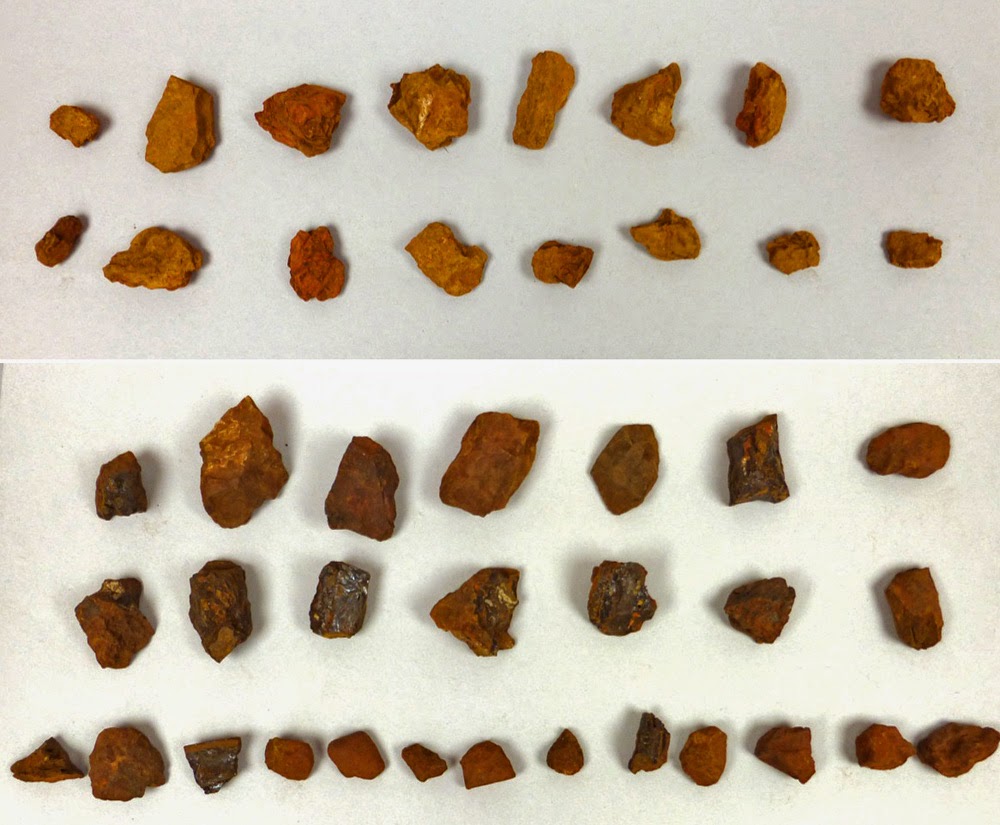
Iron ores come in the form of iron oxide minerals that vary in chemical make-up and also in colour, from dark grey to bright yellow, deep purple to rusty red. The two principal iron ores are haematite and limonite, both mined for the production of iron since at least 2500 BCE. Among the Nyoro people of Western Uganda, a soft ‘female’ ore galimuzika is smelted together with a harder ‘male’ ore nyaitume  – both named after the local hills from which they were mined – to produce a softer, more workable iron.

Soft 'female' ore (top) is smelted with harder 'male' ore (below), Nyoro people, Uganda.
Collected by John Roscoe during the Mackie Ethnological Expedition; 1921.9.57-.58

Mock-up display with sections for tools, bellows and casting
The 'Forming' section will focus on three techniques evidenced by the collections  - casting, forging and wire-making.

Casting is a complex process, one most easily demonstrated visually rather than described. We hope that placing tools, apparatus and objects together will help illustrate the various stages of the lost-wax ('cire-perdue') method and give some sense of the time and skill involved in creating a cast object. The casting section includes wax moulds from Benin, aluminium jewellery from Sudan, a complete set showing how to cast with cuttlefish bone, and this wonderful set of heads from Togo (below).

Three stages of casting a brass head, Yoruba people, Togo; 1910.48.1-.3   
1. Inner clay core; 2. Wax model covering core; 3. Outer clay mould broken to reveal cast brass face

The 'Decoration' section will feature several items illustrating surface ornamentation through hammering from the reverse side to create low-relief design (repoussé) and its opposite - punching or hammering from the front side (chasing).

This treasure-box on a detachable wheeled tray is decorated with repoussé proverb figures, symbols and repeating designs. Like copper, gold, silver and lead, brass is a malleable metal and, in thin sheets, is well-suited to repoussé work. The treasure box was probably used to store personal items of value. It is associated with the Asante (Ashanti) Empire, which thrived from 1750 onwards, in what is modern-day Ghana. Natural gold resources in the dense forests of southern Ghana brought wealth and influence to the Asante, enabling the production and trade of beautiful items like this. 

Brass repoussé treasure box, Asante, Ghana; 1935.56.12


The treasure box was collected by one F. W. Ensor and donated after his death to the Museum by his wife in 1935. According to outgoing passenger lists leaving the UK 1890-1960, F. W. Ensor sailed from Liverpool to Accra in Ghana three times from 1900 to 1903. These dates would tie in with Britain's incorporation of the Asante kingdom into the Gold Cost colony as a protectorate in 1901. 

Adjacent in the display you will find two remarkable items of headwear known as 'tantour' or 'tantur'. Worn by high status women from the Druze community in Lebanon - the taller the tantour, the richer you were - these head ornaments were attached to the head by hooking on to a cloth cap. They are not dissimilar to the 'hennin' (conical hats) worn by noblewomen of medieval Europe, which were also usually worn with a veil. A tantour was traditionally presented by a husband to his wife on their wedding day, but the fashion for wearing them died out by the 1880s.

This particular tantour is a remarkable piece of workmanship, made of a single sheet of silvered copper, decorated with repoussé designs of cypress trees, flowering branches, birds and deer (the animals represent a particular true or caste), and inlaid with red and glass paste beads at the base. The sheet has then been wrapped into a cone, the castellated edges hammered together to create a flush join.

Left: Tantour of silvered copper, Lebanon, collected by George Davis Hornblower, c. 1902; 1920.37.3
Right: Druze woman, Shouf Mountains, wearing a tantour. Photo by Félix Bonfils, ca. 1870. Source: 
Wikimedia Commons

From these taster objects you can see that, far from being a dull tale of hammers and anvils, this metalwork display is bursting with stories relating to individuals, communities, traditions, cultures and empires. We are aiming to install in late Spring 2015 so watch this space...

For more information about the Togolese cast heads and other African metal artefacts, download our African Metalworking Introductory Guide.


Helen Adams
VERVE Project Curator/Engagement Officer


Wednesday, 4 February 2015

We've Got Mail

We are selecting objects for a new permanent display of metalwork on the first floor (Lower Gallery). Whilst searching through the museum's reserve collections at our off-site storage facility  we found this wonderful board mounted with different types of mail armour. Mail is often referred to as 'chain mail' - terminology introduced by Sir Walter Scott in his 1822 novel "The Fortunes of Nigel".


This assemblage was collected - and possibly arranged - by General Pitt-Rivers himself. Pitt-Rivers collected from many sites in London during the 1860s, often as part of early 'salvage archaeology' excavations during groundworks for civic construction projects such as the London Underground and the Victoria Embankment.


C17th-centruy mail with rounded jumped (butted) rings and f
lat, welded rings. 1884.31.41. 5 © Pitt Rivers Museum
The pieces of mail are described in an early catalogue of 1874 as "Twenty fragments of Chain armour. European and Oriental". The hand-written labels date some of them to the XVII (17th) century, and several are recorded as being recovered from the "Thames Embankment". The board has clearly been put together as an exhibit rather than a cataloguing or storage device. We have no record of whether it was ever displayed at the Pitt Rivers Museum but it may well have been displayed in Bethnal Green Museum (now the V&A Museum of Childhood) and South Kensington Museums (now the V&A) where the General's archaeological and ethnological collection was first shown to the public in London from 1874-1878 (Bethnal Green) and from 1878-1882 (South Kensington), before being donated to the University of Oxford in 1884.


The board was arranged to show a variety of different types and gauges of linkage variations within the single category of 'mail armour' - a neat demonstration of Pitt-Rivers's concept of 'typological' arrangements. Some samples are of butted or 'jumped' mail, arranged in alternating rows with solid welded rings. Butted rings were the cheapest type of mail to make and buy, though the most vulnerable to a well-placed thrust from a sword or spear. Each ring is linked to four others in the European '4-in-1' style.

There were also examples of what seemed to be imitation rivets - perhaps to give the illusion of quality or strength - plus large-gauge hooked mail with spiral links, which may have been worn by horses in conjunction with solid barding armour.

Mail with possible imitation rivets (left) and hooked mail, possibly for horses (right)
1884.31.41. 15 and 1884.31.41. 13 © Pitt Rivers Musuem

The different pieces of mail were fixed to the painted wooden board with metal staples. Many of the metal rings were suffering from corrosion and rust and some links were missing. When the items were sent to our Conservation lab, our conservator Andrew rearranged tangled links and cleaned the metal with a sponge and stiff brush.

Of the twenty small pieces, a handful demonstrating the different mail types were chosen for the new Metalwork display. One substantial piece of fine mail was arranged flat on the left side of the board, rather like a half-folded T-shirt, but in fact consisted of a tube that opened out into a flat piece. Perplexed, we consulted the experts. Staff at the Royal Armouries were very helpful and Thom Richardson, Keeper of Armour and Oriental Collections, suggested it was part of C17th-century pajama zereh (mail trousers), worn by an Indian Mughal warrior.

Half riveted mail armour, identified as being part of Indian pajama zereh (mail trousers), India. 1884.31.41. 3
© Pitt Rivers Museum

Next, Andrew considered how to create a mount that would both support the mail for display and illustrate how it would be positioned on the body. Using a template from the armour, and based on his own leg, he made a liner out of calico, and filled it with polyester wadding. After padding it out to form a rough leg shape, he then tacked the mail to the calico with cotton thread. Research indicated this is not too dissimilar to how the armour would have been worn, as it would originally have been sewn to fabric trousers. Mail armour can adjust to many shapes and is very heavy, so this mount should support most of the weight and hopefully help visitors understand how it was worn.

Andrew at work in the Conservation lab making a new display mount for the pajama zereh leg armour
© Pitt Rivers Museum

You can see just how much work has to go into preparing just a few objects. You will be able to see the mail armour, alongside up to 200 other objects, in the new Metalwork display on the first floor this summer. In the meantime, you can still find examples of full mail shirts, plus various other armours (plate, lamellar, brigandine) upstairs on the Upper Gallery or here on our Arms and Armour site.


Helen Adams
VERVE Project Curator

Monday, 11 November 2013

Puppets at the Circus

Louisa Birkin from Giffords Circus on 2013's collaboration with the VERVE team at Pitt Rivers Museum...


The title of the show was decided: ‘Lucky 13’. We had a theme and an inkling of a show. Superstition, gypsies, chaotic Eastern European music, puppetry, shadows, the clash between the west and the east were all ideas conjured up. It was cold and snow lay thick on the ground at our remote base in Gloucestershire, but Giffords Circus were thinking of the long hot days of summer and planning our 2013 tour.


Working closely with Nell Gifford, I began to explore these themes. Responsible for the art department, I was looking for design ideas to help tell the story and visual references to use. Nell had been exploring puppetry in the early days of the shows’ development, and in particular shadow puppetry, so this seemed an interesting avenue to explore. We visited Pitt Rivers Museum to see their collections of shadow puppets from the Far East, as well as London to the V&A Museum of Childhood. I loved the effect of the silhouettes, and the idea of these dark figures in motion, on a journey and telling some sort of story. 


It was in these first stages of planning that we were approached by Pitt Rivers to work together in collaboration to extend our audience bases. It was somewhat of a coincidence that we had indeed already looked to the Museum for inspiration, as at the time they were unaware of our puppet theme. So it seemed only natural to form this friendship and use puppetry as our tie. Over the summer, staff from the VERVE team at Pitt Rivers came out to several of our touring grounds and created a children’s workshop area for families to interact in between show times. This added a new dimension to our site and proved very successful. 

If you missed this summer's show you can get a taste of it in this short video: 


After our season was over, we were offered the opportunity to put on a Giffords Circus display in the Museum. Happy to showcase the prop-making and design aspects of the show, I worked on ideas to include our initial puppet research and demonstrate how it influenced ‘Lucky 13’ and its final design. I incorporated elements of the set design with part of our scenery backdrop, some unusual costumes from the show and humanette puppets that we made and which were used to great comic effect by several of the performers. 

As well as being an interesting case to look at, hopefully it will teach a little of the behind-the-scenes work of the circus and, with any luck, reach some new audience members for Giffords. And conversely I believe some of the trusted fans of the circus may now be enticed to visit Pitt Rivers.

"Puppets at the Circus" is free to view on the Lower Gallery until 17 November 2013.