Showing posts with label museum interpretation. Show all posts

Thursday, 9 April 2015

Forging ahead with new Metalwork display

The VERVE team is currently working on a new display of metalwork on the Museum's Lower Gallery. The previous display devoted to this subject was more than fifty years old, thinly and unimaginatively arranged and labelled, and unsuitable mounting materials posed conservation risks to objects.

The old display of metalworking tools
The old display also only contained tools - items which, divorced from the materials they are used to shape and create, are perhaps less able to speak for themselves, except to experts.

The new display will feature around 200 objects including tools, raw materials and finished products, demonstrating various processes associated with pre-industrial metal manufacturing. Objects from the old display will be incorporated with items identified and retrieved from reserve collections, many of which have never been on display before. We are focusing in particular on three elements:
  • Extraction
  • Forming
  • Decoration

The 'Extraction' section presents an opportunity to explore ores, bellows and furnaces. The stages needed to get from rock to workable metal are many and ingenious, entering into the worlds of alchemy and chemistry. Whilst selecting objects for display it was interesting to learn about the different types of bellows used around the world, from the piston bellows of the Far East, the bag bellows of India, accordion bellows in Europe and the bowl bellows of eastern and southern Africa. Bellows create oxygen to fuel furnaces either for smelting ore or for heating the forge during metalworking.

Left: Man working piston bellows, Khiamniungan Naga people, northeast India, 1965;
Right: Piston bellows with exhausts and furnace bowl used in brass casting, Burma; 1888.39.30

Iron ores come in the form of iron oxide minerals that vary in chemical make-up and also in colour, from dark grey to bright yellow, deep purple to rusty red. The two principal iron ores are haematite and limonite, both mined for the production of iron since at least 2500 BCE. Among the Nyoro people of Western Uganda, a soft ‘female’ ore galimuzika is smelted together with a harder ‘male’ ore nyaitume  – both named after the local hills from which they were mined – to produce a softer, more workable iron.
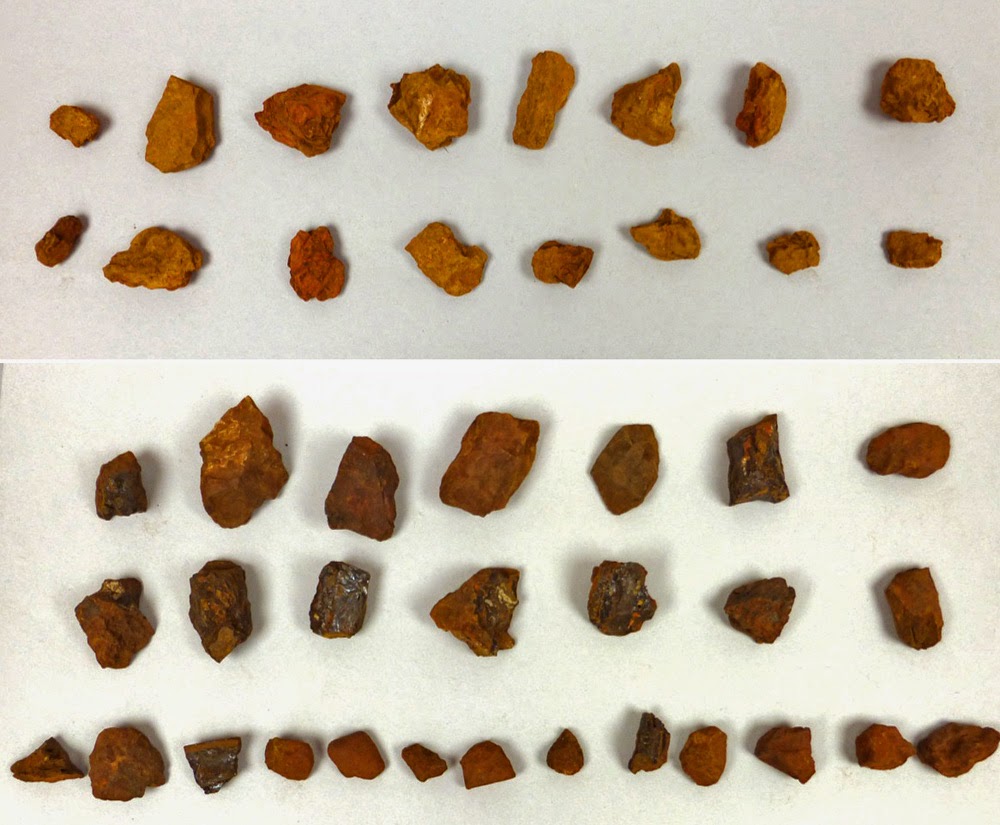
Soft 'female' ore (top) is smelted with harder 'male' ore (below), Nyoro people, Uganda.
Collected by John Roscoe during the Mackie Ethnological Expedition; 1921.9.57-.58

Mock-up display with sections for tools, bellows and casting
The 'Forming' section will focus on three techniques evidenced by the collections  - casting, forging and wire-making.

Casting is a complex process, one most easily demonstrated visually rather than described. We hope that placing tools, apparatus and objects together will help illustrate the various stages of the lost-wax ('cire-perdue') method and give some sense of the time and skill involved in creating a cast object. The casting section includes wax moulds from Benin, aluminium jewellery from Sudan, a complete set showing how to cast with cuttlefish bone, and this wonderful set of heads from Togo (below).

Three stages of casting a brass head, Yoruba people, Togo; 1910.48.1-.3   
1. Inner clay core; 2. Wax model covering core; 3. Outer clay mould broken to reveal cast brass face

The 'Decoration' section will feature several items illustrating surface ornamentation through hammering from the reverse side to create low-relief design (repoussé) and its opposite - punching or hammering from the front side (chasing).

This treasure-box on a detachable wheeled tray is decorated with repoussé proverb figures, symbols and repeating designs. Like copper, gold, silver and lead, brass is a malleable metal and, in thin sheets, is well-suited to repoussé work. The treasure box was probably used to store personal items of value. It is associated with the Asante (Ashanti) Empire, which thrived from 1750 onwards, in what is modern-day Ghana. Natural gold resources in the dense forests of southern Ghana brought wealth and influence to the Asante, enabling the production and trade of beautiful items like this. 

Brass repoussé treasure box, Asante, Ghana; 1935.56.12


The treasure box was collected by one F. W. Ensor and donated after his death to the Museum by his wife in 1935. According to outgoing passenger lists leaving the UK 1890-1960, F. W. Ensor sailed from Liverpool to Accra in Ghana three times from 1900 to 1903. These dates would tie in with Britain's incorporation of the Asante kingdom into the Gold Cost colony as a protectorate in 1901. 

Adjacent in the display you will find two remarkable items of headwear known as 'tantour' or 'tantur'. Worn by high status women from the Druze community in Lebanon - the taller the tantour, the richer you were - these head ornaments were attached to the head by hooking on to a cloth cap. They are not dissimilar to the 'hennin' (conical hats) worn by noblewomen of medieval Europe, which were also usually worn with a veil. A tantour was traditionally presented by a husband to his wife on their wedding day, but the fashion for wearing them died out by the 1880s.

This particular tantour is a remarkable piece of workmanship, made of a single sheet of silvered copper, decorated with repoussé designs of cypress trees, flowering branches, birds and deer (the animals represent a particular true or caste), and inlaid with red and glass paste beads at the base. The sheet has then been wrapped into a cone, the castellated edges hammered together to create a flush join.

Left: Tantour of silvered copper, Lebanon, collected by George Davis Hornblower, c. 1902; 1920.37.3
Right: Druze woman, Shouf Mountains, wearing a tantour. Photo by Félix Bonfils, ca. 1870. Source: 
Wikimedia Commons

From these taster objects you can see that, far from being a dull tale of hammers and anvils, this metalwork display is bursting with stories relating to individuals, communities, traditions, cultures and empires. We are aiming to install in late Spring 2015 so watch this space...

For more information about the Togolese cast heads and other African metal artefacts, download our African Metalworking Introductory Guide.


Helen Adams
VERVE Project Curator/Engagement Officer


Wednesday, 28 May 2014

Hides and Heels: work starts on new leatherwork display


With the new displays of masks and carvings in the ground floor Court now finished, we are turning our attention upstairs to the middle floor of the Museum - the Lower Gallery. The project's target area, on the left wall as you enter the gallery, is home to some rather dilapidated, fifty-year-old displays of traditional crafts. Our plan is to retain these themes but give the whole area a facelift with new displays featuring more objects - better mounted, better lit, and better labelled.

The first case we are working on will contain artefacts made of skin, hide and leather. We have decanted a large case full of headrests (these will be displayed elsewhere) to free up this much larger space for the new display. This will allow us to unite the various shoe- and saddlery-working tools that were in a smaller, previous leatherworking display with a diverse range of objects from storage, many never before displayed. 

Left: the old leatherworking case dating to the 1950s (some items were
nailed directly on to the backboard!) and the existing display of headrests,
now emptied to make way for the new Skin, Hide and Leather display. 

The VERVE team spent many hours trawling the Museum's collections database and visiting the off-site stores to identify suitable material. More than 200 objects have been carefully selected, retrieved and catalogued to show the diversity of uses, animal sources and methods of manufacture, and are now being worked on by our Conservation Department.

Boxes of leather and hide shoes (right: North American moccasins) in storage

Currently there is no special display in the Museum dedicated to footwear and it was always envisaged that the new display would provide the perfect opportunity to showcase some of the Museum's fantastic shoe collections (some of these were recently loaned to the Oxfordshire County Museums Service for an exhibition entitled 'Head Over Heels'). However, working on this case led us all to appreciate a much larger range of objects in this category; our original conception of a 'leather' display has quickly grown to incorporate membrane, skin and hide too - to tell a more complete story about human beings have worked and utilised animal skin products. We have found everything from a leather drinking tankard to Japanese shoes made from salmon skin to an English leather violin.


Leather violin 1938. 34 648 © Pitt Rivers Museum

Salmon skin shoes 1900.78.35 © Pitt Rivers Museum

The violin is full size and resembles a normal wooden one, but the body is entirely made of leather. We have been trying to find others, so far with no success, so please get in touch if have ever seen anything like this before. 

The salmon skin shoes are called Chep-kere which literally means “fish boot”. They are from Hokkaido in Japan and were used by the Ainu, the indigenous people of Japan. The shoes were soaked in water before wearing to mould them to the wearer’s foot. The salmon skin was cut and used in one piece with sewing at the toe and heel. The skin has a scaly texture, providing a good non-slip surface. This type would have only been worn in winter on the snow and may have been stuffed with grass or worn with a sock for insulation.

We also came across this fantastic pair of boots!

Gambadoes 1888.12.1 © Pitt Rivers Museum

Each foot is more than 30cm long and after an initial reaction of "giant's boots!", it became clear that these are gambadoes. They are open boots or gaiters worn whilst riding to protect their legs and trousers from mud and bushes, popular from the 17th to the 19th centuries. The buckles at the top attached to the saddle and they doubled as stirrups. This particular pair were worn by farmers in the West of England. They are made from very thick, strong leather and look very functional at first glance, but upon closer inspection they are actually decoratively stitched around the top, with moulding near the side opening and brass furniture tacks around the base.

We were fortunate and delighted to coordinate this stage of the project with a visit from the Archaeological Leather Group (ALG) to the Museum. Their group included scholars, curators, conservators, archaeologists and leather-workers and they spent several hours examining the material, helping us understand various aspects of leather-working, advising on techniques and provenance, and suggesting intepretive themes. For ALG members, it was a rare opportunity to get up close to museum collections and have personal input into the project. We had a very informative and enjoyable day and swapped several contacts to take the discussions further.

Members of the ALG examine a selection of boots, from Inuit sealskin
'wellies' to Chinese boots for bound feet, to a pair of women's boots
from Poland c. 1900 with bright pink laces © Pitt Rivers Museum

ALG members discuss an 'alum tawed' saddle and cushion from India
1966.1.1316 © Pitt Rivers Museum
We have focused on a 17th-century leather shoe-boot as our Object of the Month for June. Work will begin on designing and installing this case this summer so if you visit the Museum in the autumn, do keep an eye out for it!