Showing posts with label ethnography. Show all posts

Thursday, 7 May 2015

Crafts in the Ethnographic Film Archive

There is a small but important ethnographic film archive at the Pitt Rivers Museum. These films either accompanied donations of artefacts or photographs, or else were acquired for teaching and research purposes. Much of the material, especially that of the early 20th century, is unique and of significant historical importance. You can find all those films that have been digitised to date here.

Some of the historical footage relates to local crafts - some of which have survived and others that have not - so this is of interest to the Need, Make, Use project.

Below is a playlist of some of these films including Wanga and Isukha blacksmiths from Kenya; Kamba men from Kenya making a drum; Kwali, the remarkable potter from Nigeria; and two films shot by Ursula Graham Bower in 1939 capturing the culture and crafts in Manipur, northeast India - featuring extended sequences of weaving, brass casting and pottery, as well as dance.

Thursday, 9 April 2015

Forging ahead with new Metalwork display

The VERVE team is currently working on a new display of metalwork on the Museum's Lower Gallery. The previous display devoted to this subject was more than fifty years old, thinly and unimaginatively arranged and labelled, and unsuitable mounting materials posed conservation risks to objects.

The old display of metalworking tools
The old display also only contained tools - items which, divorced from the materials they are used to shape and create, are perhaps less able to speak for themselves, except to experts.

The new display will feature around 200 objects including tools, raw materials and finished products, demonstrating various processes associated with pre-industrial metal manufacturing. Objects from the old display will be incorporated with items identified and retrieved from reserve collections, many of which have never been on display before. We are focusing in particular on three elements:
  • Extraction
  • Forming
  • Decoration

The 'Extraction' section presents an opportunity to explore ores, bellows and furnaces. The stages needed to get from rock to workable metal are many and ingenious, entering into the worlds of alchemy and chemistry. Whilst selecting objects for display it was interesting to learn about the different types of bellows used around the world, from the piston bellows of the Far East, the bag bellows of India, accordion bellows in Europe and the bowl bellows of eastern and southern Africa. Bellows create oxygen to fuel furnaces either for smelting ore or for heating the forge during metalworking.

Left: Man working piston bellows, Khiamniungan Naga people, northeast India, 1965;
Right: Piston bellows with exhausts and furnace bowl used in brass casting, Burma; 1888.39.30

Iron ores come in the form of iron oxide minerals that vary in chemical make-up and also in colour, from dark grey to bright yellow, deep purple to rusty red. The two principal iron ores are haematite and limonite, both mined for the production of iron since at least 2500 BCE. Among the Nyoro people of Western Uganda, a soft ‘female’ ore galimuzika is smelted together with a harder ‘male’ ore nyaitume  – both named after the local hills from which they were mined – to produce a softer, more workable iron.
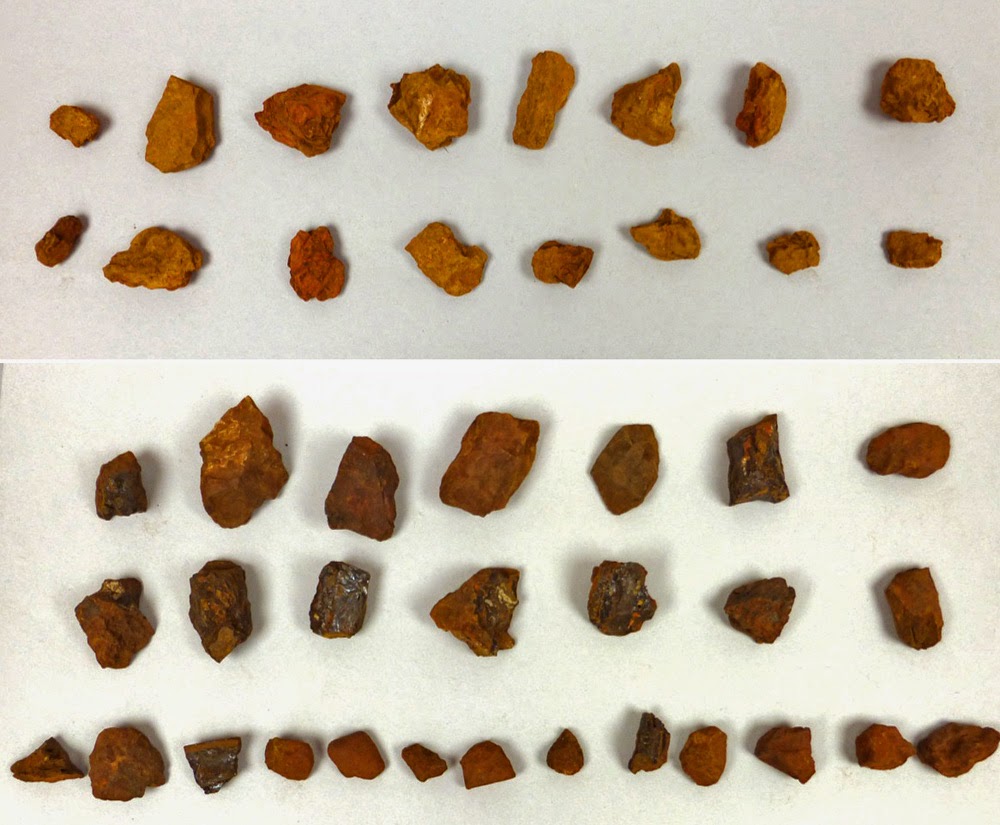
Soft 'female' ore (top) is smelted with harder 'male' ore (below), Nyoro people, Uganda.
Collected by John Roscoe during the Mackie Ethnological Expedition; 1921.9.57-.58

Mock-up display with sections for tools, bellows and casting
The 'Forming' section will focus on three techniques evidenced by the collections  - casting, forging and wire-making.

Casting is a complex process, one most easily demonstrated visually rather than described. We hope that placing tools, apparatus and objects together will help illustrate the various stages of the lost-wax ('cire-perdue') method and give some sense of the time and skill involved in creating a cast object. The casting section includes wax moulds from Benin, aluminium jewellery from Sudan, a complete set showing how to cast with cuttlefish bone, and this wonderful set of heads from Togo (below).

Three stages of casting a brass head, Yoruba people, Togo; 1910.48.1-.3   
1. Inner clay core; 2. Wax model covering core; 3. Outer clay mould broken to reveal cast brass face

The 'Decoration' section will feature several items illustrating surface ornamentation through hammering from the reverse side to create low-relief design (repoussé) and its opposite - punching or hammering from the front side (chasing).

This treasure-box on a detachable wheeled tray is decorated with repoussé proverb figures, symbols and repeating designs. Like copper, gold, silver and lead, brass is a malleable metal and, in thin sheets, is well-suited to repoussé work. The treasure box was probably used to store personal items of value. It is associated with the Asante (Ashanti) Empire, which thrived from 1750 onwards, in what is modern-day Ghana. Natural gold resources in the dense forests of southern Ghana brought wealth and influence to the Asante, enabling the production and trade of beautiful items like this. 

Brass repoussé treasure box, Asante, Ghana; 1935.56.12


The treasure box was collected by one F. W. Ensor and donated after his death to the Museum by his wife in 1935. According to outgoing passenger lists leaving the UK 1890-1960, F. W. Ensor sailed from Liverpool to Accra in Ghana three times from 1900 to 1903. These dates would tie in with Britain's incorporation of the Asante kingdom into the Gold Cost colony as a protectorate in 1901. 

Adjacent in the display you will find two remarkable items of headwear known as 'tantour' or 'tantur'. Worn by high status women from the Druze community in Lebanon - the taller the tantour, the richer you were - these head ornaments were attached to the head by hooking on to a cloth cap. They are not dissimilar to the 'hennin' (conical hats) worn by noblewomen of medieval Europe, which were also usually worn with a veil. A tantour was traditionally presented by a husband to his wife on their wedding day, but the fashion for wearing them died out by the 1880s.

This particular tantour is a remarkable piece of workmanship, made of a single sheet of silvered copper, decorated with repoussé designs of cypress trees, flowering branches, birds and deer (the animals represent a particular true or caste), and inlaid with red and glass paste beads at the base. The sheet has then been wrapped into a cone, the castellated edges hammered together to create a flush join.

Left: Tantour of silvered copper, Lebanon, collected by George Davis Hornblower, c. 1902; 1920.37.3
Right: Druze woman, Shouf Mountains, wearing a tantour. Photo by Félix Bonfils, ca. 1870. Source: 
Wikimedia Commons

From these taster objects you can see that, far from being a dull tale of hammers and anvils, this metalwork display is bursting with stories relating to individuals, communities, traditions, cultures and empires. We are aiming to install in late Spring 2015 so watch this space...

For more information about the Togolese cast heads and other African metal artefacts, download our African Metalworking Introductory Guide.


Helen Adams
VERVE Project Curator/Engagement Officer


Monday, 28 October 2013

Researching African skin-covered masks

Jill (right) and I looking at some skin-covered masks
from the collections © Pitt Rivers Museum
The Museum has a diverse and interesting collection of African skin-covered masks. I am in the process of improving upon the existing information the Museum has about these masks. I am particularly interested in how these masks are made and used. Jill Salmons and her late husband, Keith Nicklin, have researched and written extensively about this type of mask. So I was really pleased when Jill kindly agreed to spend the day with me studying this collection. Jill confirmed the art of covering an African wooden mask with skin is unique to the Cross River region of western Cameroon and southeastern Nigeria.


The Museum collection includes both cap and helmet masks, which are the two main types of skin-covered mask. Jill explained men and women are known to wear skin-covered cap masks, whereas only men are known to wear the skin-covered helmet masks, which tend to be heavier. These photographs, which Keith Nicklin took when working in the Cross River area of Nigeria, show how the cap mask is worn on the top of the head whereas the helmet mask covers the whole head, resting on the shoulders.

Left: Cap mask and costume worn by an Egbege masquerader, an all-female association, PRM 1998.480.11
Right:  Helmet mask and costume worn by a member of Nkang, an all-male association, PRM 1998.480.10
© Pitt Rivers Museum 
 

In the local communities skin-covered masks are worn for various events, including cultural displays, entertainment, festivals and rituals such as funerals and initiation. Masks are also sold and traded. During the 1970s, Keith Nicklin examined the skin-covered masks in British museums, including the Pitt Rivers Museum. Keith suspected many had never actually been used but were probably commissioned by traders and others (see Nicklin, 1979:54).

Examining a double-faced helmet mask with porcupine quills, PRM 1914.26.23 © Pitt Rivers Museum

Jill described how different the masks look when they are worn in the local communities. They are often polished with palm oil, the features enhanced with colour and additional decorations such as feathers and porcupine quills. Jill and I looked at one of the masks in the collection that still has porcupine quills inserted through the mouth and at the top of the head.   


Jill explained making this type of mask is a highly skilled, time-consuming, and intricate process. We looked at this one, which does not look like one made by a proficient carver. If you look closely, you can see bunched-up, overlapping skin around the ears and at the back.


The actual carving of the wooden part of the mask requires expertise. When the carving is finished the wood needs to be left for a few weeks to dry out before being covered in skin. A popular skin to use - partly due to its thinness - is duiker, a small antelope found in the rainforests of the Cross River. Before using, the hair is removed and the skin softened. Once ready , the skin needs to be carefully stretched, shaped to fit, and then secured on to the carving. The skin then needs to dry on to the mask before decorating. This series of photographs show Patrick Achong, a long-term friend of Jill and Keith and a skilled carver, making a skin-covered helmet mask.


Preparing the wooden mask, the antelope skin and application of the skin.
Photos by Keith Nicklin; PRM 1998.480.32, 1998.480.41, 1998.480.42 © Pitt Rivers Museum

Damaged cap mask, PRM 1914.26.14 © Pitt Rivers Museum
Jill highlighted the time and expense involved in making this type of mask. Preservation of skin-covered masks is also a problem for the local communities. The hot, humid climate renders both the skin and wood susceptible to fungal attacksinsect infestation, and rodents.

One of the wooden cap masks is in poor condition with signs of old termite damage. Jill thinks the mask probably had a skin covering but that this was eaten by rats back in Nigeria.

At the Museum we are currently working on a new permanent display focusing on Nigerian masks and masquerade. I asked Jill to help us select some skin-covered masks for this forthcoming display. Here are those choices plus some of the interesting things Jill and I found out about each one:


PRM 1942.4.9 B © Pitt Rivers Museum

Triple-faced helmets, like this one, are unusual as they are generally double-faced. This is a very well made example with finely carved features and the skin smoothly attached to the carving. This style of helmet mask is made in the Middle Cross River and is often used in Warrior Society masquerades. The darker face, which represents a male, is worn to the front, whilst the lighter faces facing backwards represent females. The markings on the latter include nsibidi symbols. Nsibidi originates in southeastern Nigeria where many different languages and dialects are spoken and creates a common form of communication between those who understand the meaning of these symbols.

A well-made cap mask with finely carved features and the skin smoothly attached. This example includes detachable horns and nsibidi symbols on the face. 

PRM 1914.26.10 © Pitt Rivers Museum


This double-faced cap mask, when looked at from this angle, clearly shows the dark male face and lighter female face with nsibidi symbols on the cheeks. 

PRM 1943.3.49 © Pitt Rivers Museum


This is beautifully carved and shaped and the brass eyes are unusual. It appears to have originally been part of a helmet mask. 

PRM 1922.67.23 © Pitt Rivers Museum


This is an interesting cap mask with light skin and a beard, and could represent a European. Alternatively, old men are also generally depicted with beards. 

PRM 1928.26.1 © Pitt Rivers Museum


This cap mask is interesting because it is not from the same region as the others. Differences include: the style of the hair, the facial markings, how the eyes have been created, the type of basketry base and the skin covering.

PRM 1938.15.39 © Pitt Rivers Museum


The sharply defined features and the shape of the mouth are characteristic of the work of a well-known, but unfortunately unidentified, early 20th-century carver. How this cap mask has been made is interesting because the skin covering goes over the basketry base. 

PRM 1943.3.48 © Pitt Rivers Museum 


People in the Cross River still use skin-covered masks for masquerade performances. We have no contemporary examples of this art of carving at the Museum. The ones in the collection were all made by 1942 at the latest. Jill and I are discussing how the Museum could acquire some contemporary examples.

I had a really rewarding day looking at the collection - my thanks to Jill for sharing such a wealth of information. She has kindly agreed to come again to look at more of the collection so keep an eye on this blog and I will keep you posted. In the meantime you can explore the African masks collection yourself via the Object Database on the Museum website. See my previous blog for some tips on using this resource.


Zena (email me)


Suggested further reading:

Jones, David, and Jill Salmons, 2011, Changing Styles: an introduction to the History of Art in the Cross River in Masquerade Mosaic: Charles Partridges Collection from Eastern Nigeria 1903-1913, David Jones (editor). Ipswich: Healeys Print Group.

Nicklin, Keith, Spring 1974, Nigerian Skin-Covered Masks in African Arts Volume 7, Number 3, pages 8-15, 67-68 & 92.

Nicklin, Keith, February 1979, Skin-Covered Masks of Cameroon in African Arts Volume 12, Number 2, pages 54-59 & 91-92.

Nicklin, Keith, and Jill Salmons, November 1984, Cross River Art Styles in African Arts Volume 18, Number 1, pages 28-43 & 93-94.

Nicklin, Keith, and Jill Salmons, 1988, ‘Ikem: the history of a masquerade in southeast Nigeria’ in West African Masks and Cultural Systems, Sidney Kasfir (editor). Tervuren, Belgique: Musée royal de l'Afrique central.

Cross River skin-covered masks (Centre for Teaching Excellence, Kansas University, 2009)