Showing posts with label textiles. Show all posts

Wednesday, 21 December 2016

Textiles in Focus Day

Event Poster
On the 29th October, the Museum was - or so it felt - entirely taken over by textiles! Working collaboratively with Conservation staff and the Collections team, the Need/Make/Use team developed an event to showcase pieces from the textile collections and offer hands-on and behind-the-scenes opportunities for visitors. In particular, we set out to highlight textiles collected by Sheila Paine during her fieldwork throughout East and Central Asia. From 16th August 2016 through to 12th February 2017, you can see a special display on the first floor of the Museum entitled Stitch of a Symbol - Insights into the textile journeys of Sheila Paine. You can read a great article about Sheila Paine here.


Stitch of a Symbol gallery display
Going behind-the-scenes
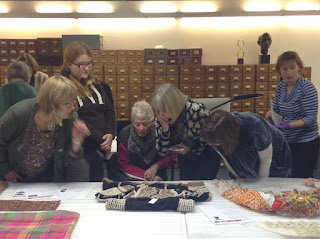
Visitors were able to book a place on a special behind-the-scenes talk led by Curator and Joint Head of Collections, Julia Nicholson. Visitors were able to see close-up objects specially taken off of display and retrieved from the Museum's stores. 


Textiles in the research space © Pitt Rivers Museum
Curatorial Assistant, Nicholas Crowe, and Curator and Joint Head of Collections, Julia Nicholson, laying out objects in the research space ready for the tours. 


Visitors in the research space © Pitt Rivers Museum
Beautiful and intricate objects were laid out in the research space. Visitors were able to take photos, hear Julia talk about how the objects were acquired and learn a bit about their history. It was excellent to hear many of the visitors puzzling between themselves about how they thought garments were constructed and exactly how decorations were applied. Through opportunities such as this, we hope to facilitate visitors to get thinking about the intricacies of construction and about the individuals who made - and still make - such objects.

Floral brocaded ribbon (Slovakia 2008.117.5) © Pitt Rivers Museum
Mola (Panama, 1924.46.74) © Pitt Rivers Museum

Waistcoat and blouse (Slovakia, 2008.117.1-.2)
© Pitt Rivers Museum
Tapestry panel (Peru, 1952.7.69) © Pitt Rivers Museum


Huipil blouse (Guatemala 1990.46.1) © Pitt Rivers Museum
Visitors in the research space © Pitt Rivers Museum

Weaving demonstrations and object handling
The balcony space on the first floor was filled with textiles from our handling collections - visitors were able to pick up and look closely at all sorts of objects - contrasted in different ways - from around the world. One of the days highlights was Head of Conservation, Jeremy Uden, demonstrating weaving on an 8 shaft loom. Visitors of all ages seemed to find this intricate and time consuming work really interesting and asked many questions throughout the day! With help from VERVE volunteers, people could also have a go at weaving on a 4 shaft loom. 


Head of Conservation, Jeremy Uden, demonstrating
an 8 shaft loom. © Pitt Rivers Museum
Visitor using a 4 shaft loom © Pitt Rivers Museum


Volunteers and visitors have a go at 4 shaft loom weaving using patterns designed by Jeremy Uden, Head of Conservation. 


Colourful handling objects © Pitt Rivers Museum

Handling objects - Huipil blouses from Guatemala (2016.223.edu and 2016.219.edu) and a backstop loom likely to be from South America (2002.168.edu). 


Handling object - toy doll in traditional Uzbek dress
(2016.608.edu) © Pitt Rivers Museum 

Coffee and cross stitch  
To finish off their visit, we invited people to join VERVE staff and volunteers for a coffee and to have a go at cross stitch in our seminar room. Each cross stitch design had been specially created by VERVE volunteers and reflected patterns found on the women's hats in the Sheila Paine collection. People could take away patterns and the work they had begun to continue cross stitching in their own time. Some visitors said that this was the first time they had cross stitched since childhood and that they now felt inspired to keep going with the craft. Others had never tried cross stitching before and learnt a new skill whilst also connecting with the collections in a new way. 


Designs based on 2008.116.22 - a panel made for a
women's skull cap © Pitt Rivers Museum
Cross stitching © Pitt Rivers Museum
Finished cross stitch © Pitt Rivers Museum
A new convert to cross stitching shows off her completed design! 


All in all, Textiles in Focus Day was a real success, offering more than 400 visitors the chance to closely examine the textiles in the collections and get some insight into the people who still make and use such items today. 

Keep an eye on our what's on pages for information about other events like this one ... in 2017 we are offering monthly hands-on workshops (such as prehistoric knife making!) that provide the chance to explore the making methods behind objects in the collections. 

Jozie Kettle
VERVE Programming and Communications Officer

Monday, 31 October 2016

Archaeology Displays Update

Museum staff arranging metal objects ©Pitt Rivers Museum
The new archaeology displays in the Pitt Rivers Museum will be displayed by type of material, rather than by chronology or geography.  The objects for these displays have been selected and now the time has come to layout all the objects to determine their final positions in the cases.  Prof Dan Hicks was involved with the final selection, Technicians Alistair and Adrian advised regarding the placement of objects in the cases and Conservator Miriam recommended ways to support and protect the objects.

The run of 10 archaeological cases is 17 metres in length and so it is important to see the potential layout of the cases next to each other.  The team spent three days working through the the displays which will show archaeological objects made of stone, metal, bone, glass, ceramic, wood and textile.


This case contains examples of spindle whorls © Pitt Rivers Museum

We started with the stone case.  The PRM has over 10,000 archaeological objects; most of these are stone tools so we had a lot to choose from. The carved stone piece in the centre of the photograph is a fragment of limestone (1884.138.12) excavated by Lt. Gen. Pitt-Rivers himself from Caesar’s Camp near Folkstone.

A close up of objects made of wood © Pitt Rivers Museum
Organic material is less likely to survive in the archaeological record but the museum holds some interesting examples to display in the case.  This case contains an intriguing wooden mummy face (1890.25.3) from Ancient Egypt 3rd Intermediate period excavated by Flinders Petrie and a mystery wooden object, possibly a lock, from a bog in Aghabullogue, Ireland (1884.117.1).

A close up of textiles © Pitt Rivers Museum

Archaeological textiles pose a problem for the museum conservation team.  These textiles are fragile and vulnerable to UV light, high lux light levels and to museum pests.  The conservation and technical services departments are investigating methods to control light levels and protect the textiles on display.

A close up of objects made from bone © Pitt Rivers Museum

The bone case contains examples of bone, tooth, shell and horn.  This case contains many small objects.  During the layout we took the opportunity to test the case text.  We printed mock up labels and tried placing the labels along the side edges of the cases.

The Archaeology Stone case in situ © Pitt Rivers Museum

The first display was installed on the Upper Gallery in October 2016.  Keep an eye out for more appearing soon!

Madeleine Ding and Sian Mundell
VERVE Curatorial Assistants

Tuesday, 17 November 2015

Visible Mending with Tom of Holland

This autumn we ran two 'Darning Masterclasses' with textiles practitioner Tom van Deijnen (AKA Tom of Holland). They sold out almost instantly. Here, Tom explains his techniques and celebrates 'visible mending', many examples of which can be found on objects in the Pitt Rivers Museum collections!


Detail of a gourd vessel, decoratively repaired
using beads; 1979.20.167 © Pitt Rivers Museum
"There is a temporary case exhibit at the Museum (until 3 January 2016) called 'Preserving What is Valued' and an accompanying museum trail. They demonstrate how people from all parts of the world repair their material culture. Conservators study objects in great detail and part of their role is to determine at what stage a repair has been made. If the repair was made by the originating community while it was still in use this provides an additional level of information and can give the object a deeper resonance. Identifying an original repair can raise questions that make us think about the object’s history differently.


"I was invited to run two darning classes as part of the events accompanying this display. My name is Tom and I’m a self-taught textile practitioner, and one of the things I do is run the Visible Mending Programme. Through this programme I seek to highlight that the art and craftsmanship of clothes repair is particularly relevant in a world where more and more people voice their dissatisfaction with fashion’s throwaway culture. By exploring the story behind garment and repair, the programme reinforces the relationship between the wearer and garment, leading to people wearing their existing clothes for longer, with the beautiful darn worn as a badge of honour.


"A mother's work" Repair commission for a private client © Tom van Deijnen

Left: Swiss darning in action by one of the participants. Right: a completed practice swatch,
showing a stocking darn and rows of Swiss daring in bold colours. © Tom van Deijnen


"The darning classes were well attended and the participants were taught two classic knitwear repair techniques: firstly Swiss darning, also known as 'duplicate stitching', which is a good way to reinforce thinning fabrics such as elbows on sleeves, or to cover up stains.


"The second technique taught was the classic stocking darn, using a darning mushroom. It creates a woven patch that is integrated with the knit fabric, and is a good way to repair holes. Of course this is best known for sock repairs.

"Throughout the classes, I shared many hints and tips on repairing, such as what tools and materials to use for best results, examples of my work, and how to look after your woollens. Half-way through  we had a break, and everybody was encouraged to see the display cabinet and follow the museum trail to find original repairs.


The Pitt Rivers Museum is home to many repaired objects from all over the world, as well as closer to home. Shown here are details from a delicate muslin handkerchief with some rather crude darns, and and a tortoiseshell comb mended with a riveted metal strip, both from a collection made in Essex, UK; 1949.9.121 and 1949.9.373 © Pitt Rivers Museum

"I found the repairs very inspiring: an inventive use of locally available materials such as baste fibres, small decorative additions such as beads, or the neat way stitching cracks, the use of staples, or even items made in such a way that they could be easily repaired in the future. I won’t go into too much detail, as it’s fun so go and see it all for yourself!


Tom van Deijnen

http://tomofholland.com

The Preserving What is Valued case exhibit and museum trail at the Pitt Rivers Museum, Oxford, 29 June 2015 – 3 January 2016. More information."


Thursday, 5 March 2015

Crafternoon at Pitt Rivers

Crafternoon has recently come to an end at the Pitt Rivers Museum after a successful three-month stint as part of the Need / Make / Use project. The outcome of our congregations is a Pitt Rivers-inspired quilt, which has been donated to the Museum.


© Pitt Rivers Museum

What is Crafternoon?
Crafternoon began in Oxford in 2012. We are a group of parents/caregivers and young kids who meet once a week. Crafternoon combines childcare with co-working for parents and caregivers who have a creative practice or an interest in crafts. These crafts are undertaken at various levels from hobbyist to professional. This rich mix of experience and expertise has led to the transfer of skills and sharing of ideas. The aim of Crafternoon is to normalize the idea of having children present while adults are productive in another task, taking the popular idea of "co-working" to another level by including our children. 

Crafternoon and Pitt Rivers
Holding these sessions at the Pitt Rivers Museum couldn't have been a better fit. Not only do many of the objects in the Museum’s collection have a direct connection with parenting and childhood, many of the objects will have been produced by hand, in community settings, in the presence of children.  

For our residency at the Museum we worked on a group project - a quilt. The imagery depicted in the quilt was inspired by objects in the galleries which relate to parenthood, childhood and co-working. With the help of Maya Herbolzheimer, VERVE Activities and Outreach Officer, we were introduced to these objects through object handling and tours of the displays. We used a series of questions to think about the 'biography' of these objects and brainstormed some possible visual representations of these biographies.


With the help of our expert seamstress and quilter, Caroline King we depicted our chosen objects using appliqué and embroidery techniques. Each participant worked on an individual square which was then sewn into one large quilt. Some of us had experience sewing and some had none – we even had contributions from some of the kids themselves! 


Every Crafternoon session is an experiment. We are never sure what the dynamics of the group will be like. But the stars were well aligned for these sessions! As the adults worked, the children got on with playing or contributing to the creative process alongside the adults. It was a calm enjoyable atmosphere. 


Our quilt has thirteen individual squares depicting baby carriers, a wolf's tooth amulet, moccasins, and a Haida totem pole - to name a few. A wolf's tooth amulet was the first object we looked at and discussed. It originates from France and was worn by children to ward off febrile convulsions caused by high fevers that can occur during teething. One of the Crafternoon participants was very familiar with these seizures as both her children had them. She chose to depict the wolf's tooth in a very creative way: using coloured squares of fabric she represented the heat of fever contrasted with the coolness provided by the amulet, "The warm colours represent fever, which is spreading and taking over the body, until it comes up against the amulet - then it disappears and we're left with a tiny, calm, cool colour." 


A personal favourite is this 3D baby carrier. Here's the maker's account of her handiwork:

"My quilt piece was inspired by a small (15 cm) model of a Saami cradle made of wood covered with leather and cloth from Sweden. I was super happy to find it; it brought back happy memories of Sweden were Abel is born on the first day of snow during a cold but beautiful winter. We spent those days outside walking in the snow or skating on the ice, and Abel napped outside, tucked in a sheepskin blanket to keep him warm in the freezing cold (it sounds funny, but many mothers do this in Scandinavia). For me, the little cradle became a symbol of happy times carrying, nursing and caring for my newborn in nature, while being free to go anywhere."


This Pitt Rivers Crafternoon quilt is a tactile educational object as well as a testament to what can be achieved together in the presence of our kids! If you visit the Museum this spring, please do check it out!

                                              
Crafternoon is now back at home in the Jericho Community Centre on Tuesdays from 2–4pm. Check our website for information and updates.

Sarah Cullen, Crafternoon


Monday, 18 November 2013

Need/Make/Use tent panel community art project

Oxfordshire-based artist Anne-Marie Cadman reflects on her experience working with four adult community groups to create large decorative panels for the Need/Make/Use 'pop up Pitt Rivers' tent during 2013. We think the panels look stunning so thank you to Anne-Marie, Fusion Arts and all the participants. You'll be able to see the tent in action at venues in summer 2014 so look out for news on where we'll be! 


The project is now complete and I’m finally able to look back and jot down some thoughts about how it went and the different groups I had the pleasure to meet and work with.

This was the first group and before we started I couldn’t help wondering if I had bitten off more than I could chew considering the size of calico we were about to work on 3m x 2.5m!


I needn’t have worried.

The group meet in the most fantastic light, large and well equipped room at the top of the Old Fire Station – I confess to having studio envy!

The participants were all very accomplished artist in their right and we soon settled into a core group who saw the challenge through to the end.

We started with a trip to Pitt Rivers for inspiration – one member returning with over 100 photos. Once we got going it was great to see the piece (which had to be climbed on to get to the middle) progress week by week and become more detailed and layered with dyes, fabric markers and stencil prints.

It was truly a fantastic start for the project and a very high bench mark for the other groups to match.


Artscape meet at the studios at Fusion Arts on a Tuesday morning. They are a group of older art enthusiasts and so clambering onto the table was not an option for this group. My other challenge was that we only had three sessions to work on the banner, so some creative thinking was needed. 


The answer was to do something different each week and bring all the elements together at a later date. Inspiration came from two chance conversations. The first was from the group’s coordinator asking if we could somehow incorporate some photography they had been doing in previous sessions, the second from one of the Pitt Rivers staff who wondered what a contemporary take on a totem pole would look like. The answer was the central ‘totem’ of the finished banner, which by turning the photography into a silk screen enabled the images full of memory, ancestry and heritage to be printed onto a totem inspired painted background.

In other sessions we created borders with hand painting and stencil printing techniques. Our third process was the production of individual pot shaped textile collages which were sewn onto the background surface with the top edge left unsewn to make pockets which could hold artefacts or information when the tent was out and about.


This group is a self advocacy organisation of adults with learning difficulties who meet in Oxford at The Jam Factory. We decided we would produce the banner at the Fusion studios as we would need more space.

Again this banner would be made in sections and I was able to work with the Banbury wing of the organisation and they produced the central section.


We had an initial inspiration trip to Pitt Rivers and this time we were able to work with the handling collection, which enabled the group to produce some effective rubbings which would be later turned into screen prints and added to the banner.

The group was keen to publicise its involvement in the project and wanted their logo included. This was balanced with the ‘Need, Make,Use’ VERVE logo and worked effectively in the final piece.

More textile sandwiches or collages were made, this time circular. Again to be used as pockets. This banner took on a circular and stripe theme to give it its unique identity.  We worked hard during the sessions and a well-earned rest and cup of tea with a biscuit was essential!

My favourite section of this beautiful banner was the ‘hands’ stripes. Participants painted designs onto the fabric, then stencils created from their own hands and arms were overlaid and printed around with a darker colour to produce this striking element. It also helped to reinforce the sense of the ‘handmade’ that is such an important feature of the Pitt Rivers collections.


This was the last group and summer was well and truly upon us.  A picnic in the park during our Pitt Rivers visit was a good way to get to know the participants better and great lunches were one of the highlights of this group, provided by Aida, one of the organisations enthusiastic and lovely coordinator.


This banner worked in a similar way to the Crisis one, in that it was created in one piece, this time on the large floor space at the BYHP headquarters. We had lots of different people working on this piece and like the Crisis banner strikingly depicted specific pieces from the collection.

A line of animals travels across the background as a final stencil print. This was influenced by one participant being particularly taken with a tiny carved object spotted in one of the cabinets at our museum visit.


I was particularly thrilled to see the finished and adorned tent on the Need/Make/Use Day event at the end of the summer. You really got a sense of it as a vibrant and working space and I think a very fitting advertisement for the Pitt Rivers Museum. It was also a good opportunity to catch up with some of the contributors.