Showing posts with label conservation. Show all posts

Wednesday, 21 December 2016

Textiles in Focus Day

Event Poster
On the 29th October, the Museum was - or so it felt - entirely taken over by textiles! Working collaboratively with Conservation staff and the Collections team, the Need/Make/Use team developed an event to showcase pieces from the textile collections and offer hands-on and behind-the-scenes opportunities for visitors. In particular, we set out to highlight textiles collected by Sheila Paine during her fieldwork throughout East and Central Asia. From 16th August 2016 through to 12th February 2017, you can see a special display on the first floor of the Museum entitled Stitch of a Symbol - Insights into the textile journeys of Sheila Paine. You can read a great article about Sheila Paine here.


Stitch of a Symbol gallery display
Going behind-the-scenes
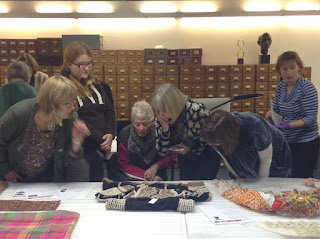
Visitors were able to book a place on a special behind-the-scenes talk led by Curator and Joint Head of Collections, Julia Nicholson. Visitors were able to see close-up objects specially taken off of display and retrieved from the Museum's stores. 


Textiles in the research space © Pitt Rivers Museum
Curatorial Assistant, Nicholas Crowe, and Curator and Joint Head of Collections, Julia Nicholson, laying out objects in the research space ready for the tours. 


Visitors in the research space © Pitt Rivers Museum
Beautiful and intricate objects were laid out in the research space. Visitors were able to take photos, hear Julia talk about how the objects were acquired and learn a bit about their history. It was excellent to hear many of the visitors puzzling between themselves about how they thought garments were constructed and exactly how decorations were applied. Through opportunities such as this, we hope to facilitate visitors to get thinking about the intricacies of construction and about the individuals who made - and still make - such objects.

Floral brocaded ribbon (Slovakia 2008.117.5) © Pitt Rivers Museum
Mola (Panama, 1924.46.74) © Pitt Rivers Museum

Waistcoat and blouse (Slovakia, 2008.117.1-.2)
© Pitt Rivers Museum
Tapestry panel (Peru, 1952.7.69) © Pitt Rivers Museum


Huipil blouse (Guatemala 1990.46.1) © Pitt Rivers Museum
Visitors in the research space © Pitt Rivers Museum

Weaving demonstrations and object handling
The balcony space on the first floor was filled with textiles from our handling collections - visitors were able to pick up and look closely at all sorts of objects - contrasted in different ways - from around the world. One of the days highlights was Head of Conservation, Jeremy Uden, demonstrating weaving on an 8 shaft loom. Visitors of all ages seemed to find this intricate and time consuming work really interesting and asked many questions throughout the day! With help from VERVE volunteers, people could also have a go at weaving on a 4 shaft loom. 


Head of Conservation, Jeremy Uden, demonstrating
an 8 shaft loom. © Pitt Rivers Museum
Visitor using a 4 shaft loom © Pitt Rivers Museum


Volunteers and visitors have a go at 4 shaft loom weaving using patterns designed by Jeremy Uden, Head of Conservation. 


Colourful handling objects © Pitt Rivers Museum

Handling objects - Huipil blouses from Guatemala (2016.223.edu and 2016.219.edu) and a backstop loom likely to be from South America (2002.168.edu). 


Handling object - toy doll in traditional Uzbek dress
(2016.608.edu) © Pitt Rivers Museum 

Coffee and cross stitch  
To finish off their visit, we invited people to join VERVE staff and volunteers for a coffee and to have a go at cross stitch in our seminar room. Each cross stitch design had been specially created by VERVE volunteers and reflected patterns found on the women's hats in the Sheila Paine collection. People could take away patterns and the work they had begun to continue cross stitching in their own time. Some visitors said that this was the first time they had cross stitched since childhood and that they now felt inspired to keep going with the craft. Others had never tried cross stitching before and learnt a new skill whilst also connecting with the collections in a new way. 


Designs based on 2008.116.22 - a panel made for a
women's skull cap © Pitt Rivers Museum
Cross stitching © Pitt Rivers Museum
Finished cross stitch © Pitt Rivers Museum
A new convert to cross stitching shows off her completed design! 


All in all, Textiles in Focus Day was a real success, offering more than 400 visitors the chance to closely examine the textiles in the collections and get some insight into the people who still make and use such items today. 

Keep an eye on our what's on pages for information about other events like this one ... in 2017 we are offering monthly hands-on workshops (such as prehistoric knife making!) that provide the chance to explore the making methods behind objects in the collections. 

Jozie Kettle
VERVE Programming and Communications Officer

Thursday, 20 October 2016

New techniques in soft-mount making at the Pitt Rivers Museum

Recently, in the conservation lab we have been busy preparing objects for a new display. Rank and Status in the Pacific is one of the new VERVE displays, which are being installed in the Lower Gallery. The case presents a range of items, including jewelry, clothing and ceremonial sticks, representing emblems of authority and status in the Pacific.

A large number of soft mounts, mostly consisting of padded MDF boards covered in Jersey fabric, were required to support the many neck ornaments, which feature in the display. However, two particular objects, a headband 1989.28.11 and a shell necklace 1990.22.3, offered us the opportunity to be more experimental with our mounts. We decided to create a head-and-neck 3D mount, which would display the objects as they would have been worn. This mount will be the centerpiece of the case.

To create a mount of this kind we would normally use a method called buckram, which consists of covering a mould, usually a mannequin, in layers of linen strips impregnated with starch paste which, once dry, create a cast of the mould.  Although this method is very efficient and very popular among conservators and mount makers, it can be very time-consuming, especially when many layers of linen strips are required to achieve the desired shape and strenght. Each layer in fact has to be completely dry before a new layer can be applied.

However, a new material, called Fosshape (Fosshape™), is becoming more and more popular among conservators and mount makers as an alternative to buckram for making soft mounts. Fosshape has been designed and used mostly in the millinery industry and it is a thermoplastic, non-woven, synthetic fabric, which can be molded into any desired shapes using vapour and heat. Earlier this year, I used the same material to create a hand-shaped mount for a leather glove 1911.29.85 used in the masonry industry, which is now on display in the Stonework display in the Lower Gallery.

Leather glove 1911.29.85 mounted on a hand-shaped mount made of Fosshape, front (left) and back (right) 
           
In April, Jeremy Uden, Deputy Head of Conservation, and I also attended a one-day training session at the textile conservation lab at the V&A with Textile Conservation Display Specialists Rachael Lee.  At the V&A, Fosshape is used extensively. Due to its versatility, ease and speed of use, it is an ideal material to adapt mannequins and create desired silhouettes for costumes. Our day at the V&A textile lab, gave us a chance to practice further with Fosshape and improve our skills under Rachael’s direction, and to observe how versatile this material can be and what great potential it has for use in conservation and mount making.

Although it is great fun to work with Fosshape, it must be said that creating complex mounts out of it can be tricky. For our first attempts, the hand-shaped mount mentioned above and the head-and neck mount, we set our goals pretty high.

The first step was to select a suitable mannequin’s head to use as a mould on which to shape the Fosshape. Given the size of the headband, which we were making the mount for, we needed a fairly small head. Finding a mannequin of a suitable size can be difficult when only a few are available in a small lab.  Fortunately, the mannequin available to us was perfect for the job. 

Our mannequin head is covered in calico fabric, which has been cut into eight sections and sewn together to create a perfect fit for the head. We decided to use a similar pattern to cut the Fosshape into eight pieces, which we then sewed together. We chose to use Fosshape 600 grs for this project, as it creates stronger mounts than the Fosshape 300 grs, which is more suitable for smaller, lighter mounts, like the hand-mount shown above.


Sewing patterns
Once ready, the Fosshape was turned inside-out and fitted onto the mannequin head again ready to be shrunk with heat and vapour from an iron. To ensure that the mount could be removed from the mannequin, the back of the mount was stitched by hand. 

Fosshape sections sewn together and fitted onto the mannequin, front (left) and back (right)
A wet piece of calico was used as a barrier between the mount and the iron, partly to generate more vapour and partly to protect the mount from potential burns. We shrunk the Fosshape to a point where we felt comfortable that it was still flexible enough to be removed from the mannequin, while still being able to retain its shape. Once removed from the mannequin, which required a significant amount of teamwork in order to plan, pull and remove it without causing any damage to the mount or the mannequin, the Fosshape mount was stitched back together.

Jeremy shrinking the Fosshape 
Fosshape mount shrunken and ready to be removed from the mannequin, front (left) and back (right)


Although our mount at this stage was already quite strong, following advice from Rachael, we decided to add a layer of buckram for additional strength. The mount was left to dry overnight and the next day was ready to be covered in fabric. We used the same pattern created for the Fosshape to make a black Jersey cover to fit the mount. At this stage, it is impossible to stitch through the Fosshape as it is completely hardened. This meant that the Jersey had to be stretched out gradually onto the mount, using pins. Whereas the majority of the cover was machine sewn, the back of the mount was hand-stitched. At the base of the neck, the fabric was tucked inside and hot-glued to the mount. 

Fosshape mount covered with a layer of buckram 
Miriam sewing the Jersey fabric cover (left) and Jersey cover nearly completed (right) 

Ultimately, the headband mounted on Polyfelt covered in black jersey, was attached to the head using Velcro, and the necklace was fixed onto the mount using nylon monofilament wire.


Headband and necklace mounted onto the Fosshape mount, front (top center), side (bottom left), back (bottom right)

The results of our experimentation were highly pleasing. Aside from being a really useful, alternative, material for soft mounts, we were able to assess the huge potential that Fosshape has to aid the interpretation of objects in our displays. Rank and Status will be installed soon… Watch this space!

Miriam Orsini
VERVE Conservator

Wednesday, 29 January 2014

Redisplaying Naga baskets

Our work creating new displays along the upper tier of the Museum's ground floor (Court) continues. Currently we are turning our attention to the north side, focussing on Naga material, including a large number of Naga baskets. The Naga comprise several tribal groups living in northeastern India and northwestern Burma. The Museum has rich Naga collections, largely due to substantial donations by John Henry Hutton and James Philip Mills in the 1920s. 

The old display of Naga baskets (with new lighting) © Pitt Rivers Museum

Watercolour of Naga man with dao, 
shield and basket. 1893.7.14 
As part of the project, our plan is to significantly improve the Naga baskets display, which has been unchanged for many years. Such baskets were made and used by men, associated with the Naga tradition of head-taking, which is no longer practised. They are varied in construction and appearance, decorated with carved wooden heads, monkey skulls, boars'  tusks, goat hair, grass and palm tassels and even whole birds. We want to improve how these objects are mounted and reduce the number of items in the case to create more space for them to be seen and appreciated individually, rather than just as a collection.

The old display contained 32 baskets, tightly packed into two display cases. They all have long handles but being so tightly packed meant that many of the handles had been folded inside the basket, plus many of the attached tassels overhung other baskets or were squashed against the bottom of the case making access difficult. In addition, many of these tied-on decorations have become detached.


Now, all the baskets have been removed from their cases to be carefully catalogued and photographed. They are undergoing conservation treatment which involves being cleaned of any surface dust acquired whilst on display, and securing any damaged basketry or detached decoration back in place.

Most of the baskets were previously displayed by tying a short length of string to the rim and hanging them from a nail in the back of the case. Being positioned like this for many years has caused damage to the fragile woven cane structure so the new display will have individually-made mounts to provide much more support for each basket.

The new display will be designed to make it easier to see each individual basket and also show some of the elaborately woven straps, previously hidden inside each basket. This new layout incorporates 22 of the original baskets, meaning we have had to decide which baskets to remove and put into storage.

1929.22.15  © Pitt Rivers Museum

The decision on which baskets to remove (or 'deselect') was made jointly by members of the curatorial, conservation, technical teams based on various criteria - if it was too fragile to return to display, how likely it would be for the fur, bird skins and hair to be attacked by moths, the style of basketry and decorations used, and whether these demonstrated a suitable variety of techniques and materials within the theme of the case.

For example, this basket was not included in the new display for two reasons: we were concerned that it was vulnerable to pest damage (moths love fur and hair tassels!). Also it lacks any carved figures or skulls so it did not fit with the faces and figures that have so far informed the theme in the Court phase of redisplay - “the world is watching: performance and ceremony”.

As well as allowing the carrying straps to be visible for the first time, the new display will allow the outline of each basket to be clearly visible, whist new lighting will help draw visitors' eyes upwards, illuminating the baskets' shapes and colours.


The technicians' planned layout for the new Naga baskets display © Pitt Rivers Museum

The baskets that did not make the final selection have been stored in bespoke boxes since their unusual dimensions meant they would not fit any standard sized ones. This is a relatively common problem at Pitt Rivers, so many of us are very good at producing boxes made from corrugated plastic.

It is envisaged that the project's redisplay work in the Court will be completed by Spring 2014 so do come take a look at these lively arrangements of masks, figurative sculpture and re-lit boats from around the world...as well as this fascinating collection of Naga baskets.