Showing posts with label Papua New Guinea. Show all posts

Friday, 22 February 2013

An Evening of Striptease, Carnival & Forest Spirits

We hosted our second After Hours event on Wednesday. Entry to the Museum after 4.30 is via our South Door down Robinson Close off South Parks Road. It can be hard to find for those not familiar with it, so our technician Jon designed a top-storey sign to help visitors navigate to us in the dusk!


Mike O'Hanlon gives an illustrated talk about display in PNG
The theme this time was 'Masquerade and Performance' and visitors were treated to a talk by the Museum's Director, Dr Michael O'Hanlon, on the elaborate ceremonies of the Wahgi people of Highland New Guinea, amongst whom he conducted first-hand anthropological fieldwork some years ago. Enticingly entitled 'Striptease', it was fascinating to hear about the way the putting on and taking off of colourful costume, dance, shiny skin and expensive bird feather headdresses carry so much social meaning among the various clans who live there.


Also on hand were members of Sol Samba, Oxford's vibrant Brazilian carnival act. Even with just three performers, they still managed to whip up a torrent of invigorating sounds with their drums. After a demo and explanation of the history and tradition of the maracatu genre from northern Brazil, they encouraged visitors to get involved by having a go with the instruments.

Sol Samba get into the rhythm

We see these evening as great opportunities to showcase some of our recently digitised sound and film collections. In 2009, the Museum acquired an 8mm film shot in Ladakh, Tibet by Major Peter Hailey during his service there in the Second World War. The footage shows various scenes of the people and landscape, including the courtyard at Hemis Buddhist monastery where the 'cham' (masked dance) representing the eight forms of the guru Padmasambhava is performed to a large crowd. You can see the whole film here (18 mins).

Setting up the film in the galleries and a scene from the 'cham' dance

Ejengi spirit dance at Mongengé village (PRM: 1997.21.3.6)
Our ethnomusicologist Noel Lobley created a great soundtrack for the evening, featuring 'ejengi' music from the Central African Republic. Ejengi is a Bayaka spirit summoned to dance at initiation ceremonies that can last for months. The sounds represent ejengi emerging from his lair, men and women singing polyphonic songs, and leaves 'popping' in the forest. The 'spirit', dressed in plant fibre, assumes a myriad of dance forms - charging at singers, collapsing to the ground, and spinning like a waterfall. This music comes from more than 1000 hours of soundscapes that form the Museum's Louis Sarno Collection of Bayaka recordings. 

Finally, a themed quiz sent visitors off in search of masks, instruments and puppets in the gallery...


Here are the answers to the quiz:
'George Washington' puppet made
 for a performance Wilkinson gave
for Eleanor Roosevelt in the USA
(PRM 1985.36.18)

1. Name the New Ireland mortuary ceremony at which tatanua masks are worn?
'Malangan'.

2. In Japanese Noh plays, what feature of a mask denotes a female character’s emotional state – its colour, hair or expression? 
The hair.

3. Can you find and name the four ‘Peep Show’ puppets made and toured around England by Walter Wilkinson in the 1920s and 30s? 
'Russian woman', 'George Washington', 'Sally' and 'Professor'.
Walter Wilkinson was a leading figure in the revival of puppet theatre in England and toured on foot with his handcart containing his camp and a dozen hand-made glove puppets and props.

4. The open-mouth ‘aopa’ drum from Papua New Guinea uses a skin membrane from which animal?
Monitor lizard.

5. What kind of trumpet was used at the Italian festival of Piedigrotta?
Shell trumpet

CONGRATULATIONS to Mrs C. Strudwick who was picked at random from the quiz entrants and got the answers right. You win an Australian Aboriginal rain-shaker!

We'll be holding these evening openings on the third Wednesday of the month - they are a great chance for you to experience the Museum in a different, more relaxed, child-free atmosphere with a light programme of activities or entertainments. What's more they are totally FREE! We're looking forward to our next After Hours on Wednesday, 20 March where we will be launching the results of our 'Reel to Real' sound archive project. See you there!

Tuesday, 12 February 2013

Four-sidedness: boxes, houses and coffins

We continue to prepare the ground for the completion of the lighting installation and other VERVE redisplay plans by moving and re-homing material. Museum conservator Andrew has provided the following update:

Firstly, the large music collection, removed from the Upper Gallery some weeks ago, has now been re-housed in its new home at our off-site storage facility. It took some time to get the space ready due to issues relating to environmental suitability, management and the logistics of ordering enough shelving for 400+ objects and transporting them, but the task is now complete!


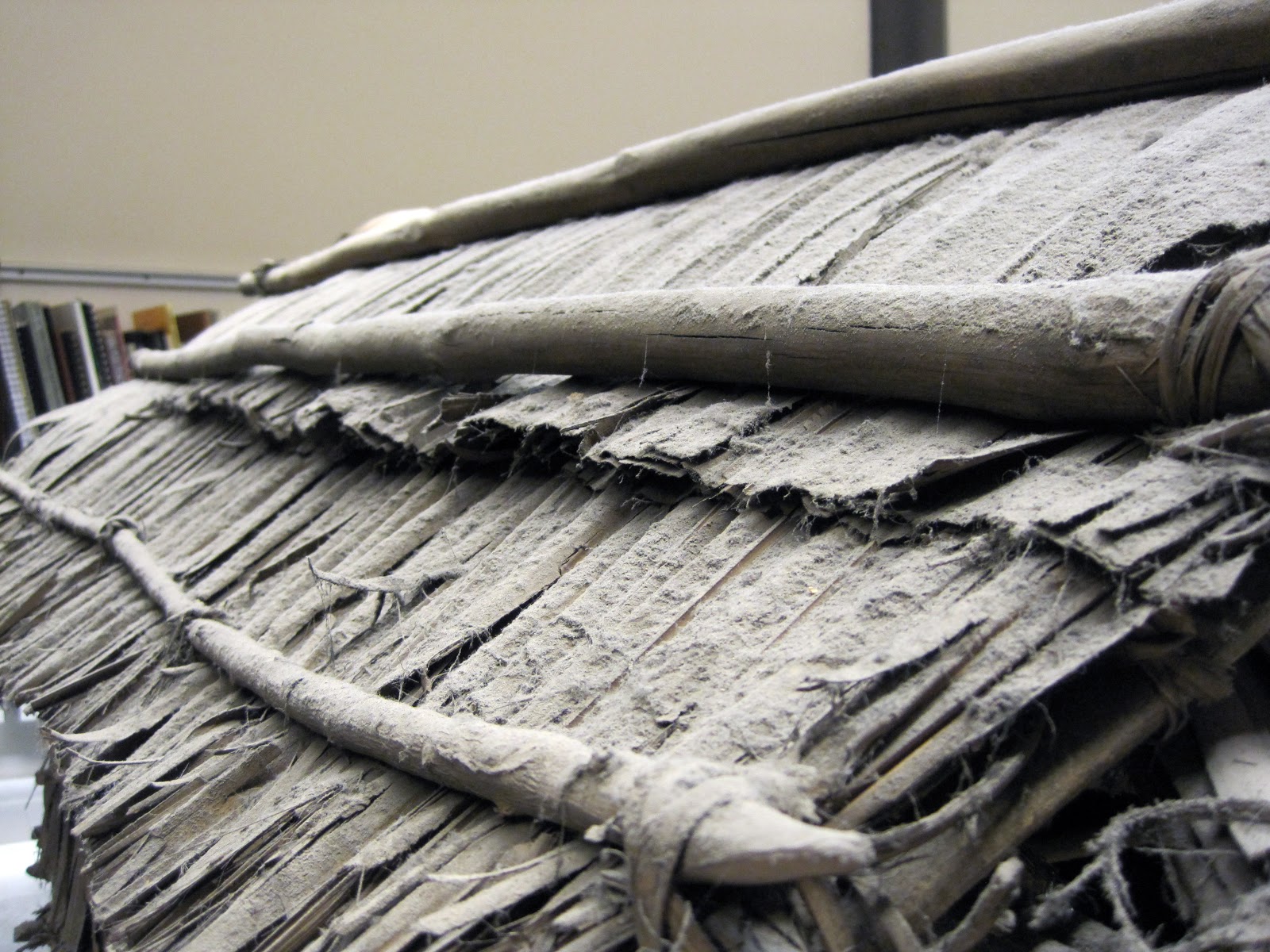
Next was the move of the second model house from Papua New Guinea. These were collected in 1888 by H. H. Romilly and were presented by A.W. Franks to the Museum in 1893 so they are old and important ethnographic objects. 

This second house is labeled: 'Model of a pile dwelling Motu Tribe, S.E. New Guinea'. It's not known how long it has been above the wall cases in the Court, but probably more than 70 years. The houses are made from palm wood and palm leaves which are very fragile and easily damaged, and it was not possible to clean them safely in situ. They were moved to the Conservation lab where we have been cleaning and stabilizing them before they return to new, more visible locations in the Court.


Technician Alan getting ready to move the model house

What 70 years of dust looks like! 

The model palm houses in the lab. The difference between
the cleaned one (foreground, PRM 1893.42.3) and the
dusty one (PRM 1893.42.2) behind it, is marked.

Andrew shows the difference a careful hoovering job can make

Lastly, as the Made for Trade exhibition was dismantled after its successful run, the specially-commissioned Ghanaian coffin from the Kane Kwei fantasy coffin workshop in Accra has been moved to a new position in the Court, above the introductory case on the left as you come down the entrance steps. Painted with product advertisements to make it look like a shop front, it makes a colourful and attractive addition to the newly lit upper levels of display.